Using AI for Effective Social Listening

Artificial intelligence is transforming social listening into a continuous analysis system capable of detecting weak signals, interpreting public sentiment, and triggering alerts before a crisis breaks out. Using artificial intelligence in social listening means moving from reactive monitoring to a proactive understanding of online conversations. Platforms such as Bright Data and Ripost illustrate this shift in practice: they combine structured scraping, natural language processing (NLP), and so-called “agentic” workflows to deliver social data analysis your teams can act on directly. This guide explains how to structure this approach, choose the right tools, and address regulatory requirements.
Which tools should you choose for AI-powered social listening?
Your choice of AI tool for social listening directly determines the quality of your analysis. Two criteria are nonnegotiable: cross-platform coverage and GDPR compliance. A tool limited to Twitter or Instagram misses a growing share of conversations taking place on TikTok, Reddit, YouTube, or LinkedIn.
Reliable access to social data at scale (in French) remains the main obstacle for teams deploying AI agents. Scraping tools such as Bright Data Social Media Scraper solve this problem by delivering structured feeds in JSON or Markdown, formats directly compatible with large language models (LLMs). This compatibility reduces data preparation time from several hours to a few minutes.

Ripost, developed by startup Intaj Digital, takes a different approach: the platform analyzes 8 social channels in real time (in French) with configurable alerts and AI calibrated to local cultural nuances. This is a decisive advantage for brands operating in French- or Arabic-speaking markets, where idiomatic expressions distort generic analyses.
| Tool | Coverage | Output format | Key strength |
|---|---|---|---|
| Bright Data Social Media Scraper | Instagram, TikTok, X, Reddit, YouTube, LinkedIn | JSON, Markdown | Scraping volume and reliability |
| Ripost (Intaj Digital) | 8 major social channels | Configurable alerts | Local cultural and linguistic adaptation |
| Integrated BI platforms | Varies by connector | Dashboards | Visualization and strategic decision-making |
Pro tip: Prioritize tools that incorporate local language recognition. A model trained on standard English will produce significant false positives on content in Darija, Creole, or regional French slang.
How do you structure an agentic workflow for active monitoring?
An agentic workflow is an architecture in which several specialized AI agents collaborate autonomously to complete a complex task. Applied to social listening, this type of workflow turns passive collection into active monitoring by continuously tracking brand mentions and analyzing sentiment to detect spikes and trends.
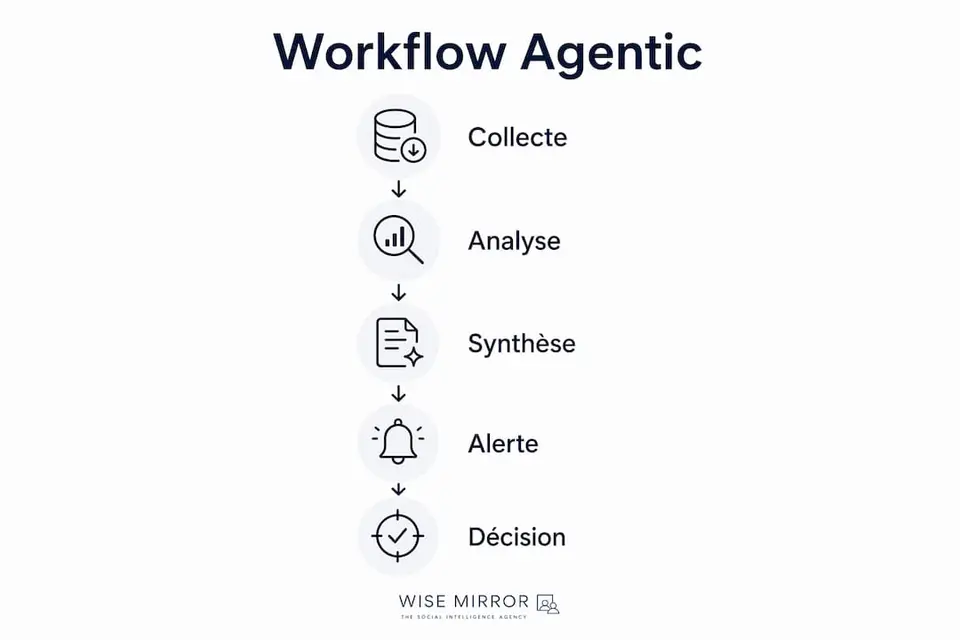
This system's performance depends less on the LLM chosen than on the quality of the upstream data pipeline: scraping, structuring, and normalization. A powerful LLM fed poorly structured data produces unreliable analysis. Investing in data quality means investing in the reliability of your decisions. For a deeper look at this issue, consult this guide to social data reliability before configuring your pipeline.
Here are the six phases of an operational agentic workflow:
- Collection: a scraping agent retrieves posts, comments, and mentions from target platforms based on defined keywords and scope.
- Cleaning: a preprocessing agent filters duplicates, normalizes formats, and removes irrelevant content (spam, bots).
- Enrichment: data is supplemented with contextual metadata (geolocation, author profile, estimated reach).
- Analysis: an NLP agent performs sentiment analysis, topic detection, and named entity recognition.
- Scoring: an aggregation agent calculates key metrics such as mention volume, share of voice, and overall sentiment score.
- Reporting: a synthesis agent generates structured reports and triggers alerts based on predefined thresholds.
Pro tip: Keep each agent's responsibilities strictly separate. An agent that collects AND analyzes introduces biases that are difficult to detect. Modularity allows you to fix one component without rebuilding the entire system.
To integrate this data into your management tools, this guide to integrating social listening and BI details the connectors available to marketing teams.
How does advanced sentiment analysis protect your brand image?
Sentiment analysis now goes beyond simple positive/negative classification. AI explains the “why” behind sentiment and enables precise actions at the right time. This interpretive capability is what distinguishes strategic monitoring from simply counting mentions.
The approach known as “aspect-based sentiment analysis” segments feedback by topic: after-sales service, price, product quality, and delivery experience. An overall score of 65% positive can hide a 40% strongly negative perception of after-sales service, a warning signal that aggregation erases. This level of granularity is what communications leaders should demand from their tools.
Several factors require particular attention when interpreting results:
- Sarcasm and irony: generic models struggle to detect them. A comment such as “Well done, another late delivery!” will be classified as positive without specific calibration.
- Emojis and cultural expressions: adaptation to the local linguistic context significantly reduces interpretation errors in non-English-speaking markets.
- Interpreting scores: a sentiment score should be read as an aggregate trend, never as an absolute truth for each individual entry. A strategic decision based on a single score without human validation is a risk.
- Alerts for negative spikes: configure trigger thresholds that combine mention volume AND sentiment score. A volume spike with neutral sentiment is less urgent than a moderate increase with highly negative sentiment.
A human-in-the-loop process using a stratified sample quickly improves decision quality without adding to the workload. In practice, manually validating 5% of critical alerts is enough to correct model drift and maintain teams' trust in the system.
Pro tip: Always cross-reference sentiment scores with mention volume and share of voice. Negative buzz that builds quietly on Reddit before exploding on X is detected first through volume, not sentiment.
Which rules apply to GDPR and AI Act compliance?
Compliance when using AI for social listening is not a technical attribute of a model. It relies on governance, an AI usage policy, a DPIA when risk is high, training, and human oversight (in French). This distinction is fundamental: choosing a “GDPR-compliant” tool does not exempt you from establishing your own governance framework.
Specific obligations include:
- Data protection impact assessment (DPIA): mandatory under Article 35 of the GDPR when processing poses a high risk to individuals' rights, particularly in cases of profiling or large-scale monitoring.
- AI usage policy: an enforceable document defining permitted uses, data processed, responsible parties, and limits on agents' autonomy.
- Traceability: the AI policy, traceability, and workflow documentation are essential records for demonstrating compliance during a CNIL audit or an AI Act inspection.
- Pseudonymization: personal data collected through scraping must be pseudonymized before analytical processing.
- AI literacy: the AI Act requires a minimum level of training for teams that use or supervise AI systems. This is not optional.
“Compliance is a comprehensive framework covering usage, governance, training, and audits. It is not a box to check when purchasing a tool.” Source: DPLIANCE, AI Compliance Guide 2026.
Shadow AI, meaning employees' undisclosed use of AI tools, represents a growing risk. This phenomenon creates significant risks of data leaks and noncompliance (in French). An analyst who pastes verbatim customer comments into ChatGPT without a defined framework exposes the company to GDPR violations without management's knowledge.
How do you manage the organizational challenges of AI adoption?
AI adoption in social listening rarely fails for technical reasons. It fails because of a lack of clear governance and team buy-in. Defining a usage framework before deploying a tool is more effective than correcting problems afterward.
Practices that make a difference in production:
- AI systems register: inventory all AI tools used by your teams, including informal uses. You cannot govern what you cannot see.
- Decision-making boundaries: explicitly define which decisions AI can make on its own, which require human validation, and which it is prohibited from making.
- Continuous monitoring: monitor model performance in production. A model that gradually drifts produces increasingly unreliable alerts without anyone noticing.
- AI governance committee: create a cross-functional body with an executive sponsor, a legal lead, and business representatives. AI decisions cannot remain in the hands of a single technical team.
- Regular training: AI literacy for communications and marketing teams is an investment that reduces interpretation errors and noncompliant uses.
Pro tip: Start by auditing existing AI usage in your organization before any deployment. In most companies, Shadow AI is already present. Identifying it and setting boundaries is more effective than banning it. To explore the use of social data in strategic decision-making in more depth, Wise-mirror offers resources tailored to decision-makers.
Key takeaways
AI transforms social listening into a competitive advantage when it combines data quality, calibrated sentiment analysis, rigorous governance, and continuous human oversight.
| Point | Details |
|---|---|
| Data quality first | Scraping reliability and data structure determine the value of AI analysis. |
| Modular agentic workflow | Separating collection, analysis, and reporting across distinct agents improves accuracy and maintainability. |
| Granular sentiment analysis | Aspect-based sentiment analysis reveals signals that overall scores hide. |
| Compliance as a comprehensive framework | The GDPR and AI Act require a policy, traceability, training, and governance, not just a certified tool. |
| Essential human oversight | Manually validating a stratified sample of critical alerts maintains decision quality. |
What experience has taught me about AI and social listening
After supporting many organizations in their approach to AI-enhanced social listening, I see a recurring bias: teams overinvest in choosing an LLM and underinvest in data pipeline quality. The most sophisticated model on the market will never compensate for poorly collected or poorly normalized data.
The second pitfall is overconfidence in automated scores. I have seen teams trigger crisis responses based on AI alerts that turned out to be misinterpreted sarcasm. Human oversight is not an admission of system weakness. It is what turns a detection tool into a decision-making tool.
When it comes to governance, the temptation is to treat compliance as a one-off project. This is a mistake. AI uses evolve quickly, teams change, and models drift. A living governance framework, with regular audits and ongoing training, is what distinguishes organizations that derive lasting value from AI from those that accumulate incidents.
Finally, cultural adaptation is underestimated in France. Brands operating in multilingual or multicultural markets must demand locally calibrated models. A generic tool applied to North African or French Caribbean content will produce analyses that mislead more than they help.
— GB
Wise-mirror: your partner for AI-enhanced social listening
Wise-mirror combines proven agentic workflows, social data analysis expertise, and senior analysts to turn your social data into concrete decisions. The agency covers the entire pipeline: cross-platform collection, culturally calibrated sentiment analysis, GDPR and AI Act compliance, and 24/7 crisis management.

Whether you want to audit your current position, establish continuous monitoring, or strengthen your incident response, Wise-mirror offers tailored support. Discover how our augmented social intelligence can turn your monitoring into a real competitive advantage. Contact our teams for an initial, no-obligation conversation.
FAQ
What is an agentic workflow in social listening?
An agentic workflow is an architecture of specialized AI agents that collaborate to automate social data collection, analysis, and reporting. It turns passive monitoring into active intelligence capable of detecting trends and triggering alerts in real time.
How does AI improve sentiment analysis?
AI goes beyond positive/negative classification by identifying specific topics, emotions, and cultural context. Aspect-based sentiment analysis detects precise warning signals, such as negatively perceived after-sales service, that overall scores hide.
Which GDPR obligations apply to AI-powered social listening?
Obligations include a DPIA if processing poses a high risk, an AI usage policy, pseudonymization of personal data, and workflow traceability. The AI Act adds training and AI literacy requirements for the teams involved.
How can you avoid Shadow AI-related mistakes?
Start with an inventory of AI tools used in your organization, including undisclosed uses. Establish an AI systems register and a cross-functional governance committee to set boundaries before these uses create legal or strategic risks.
Which metrics should you combine for effective social listening?
Cross-reference mention volume, aggregate sentiment score, and share of voice for a reliable assessment. A volume spike with highly negative sentiment is the most reliable warning signal for anticipating negative buzz before it reaches traditional media.