Social Media and Public Decisions: An Operational Guide

At a glance:
- Social media reshapes the public agenda by amplifying certain issues before they even appear in official statements.
- To anticipate these influences, leaders need structured listening with alert thresholds and clear governance.
Social media does not create public opinion, but it does reshape its agenda: this is the strongest conclusion emerging from French research today. For a communications director or executive, this has one practical implication: implementing structured social listening is no longer optional. It is essential to anticipate the priorities your organization will face tomorrow.
Three institutional reference points define this landscape in France. The Constitutional Council (in French) identifies platforms as new spaces for political dissent. In March 2025, the Council of State clarified the neutrality obligations of institutional accounts. The CNIL regulates the processing of data collected through this monitoring. Wise-mirror operates within this framework as an operational resource for turning these signals into decisions.
Immediate actions (7–30 days):
- Deploy a basic dashboard: hourly volume, seven-day trend, weighted sentiment.
- Set an alert threshold: a 30% increase in volume over 24 hours combined with negative sentiment > 40% triggers a governance review.
- Appoint a single point of contact between monitoring, management, and legal teams.
Pro tip: Start with just five metrics. An overloaded dashboard goes unread. Add indicators as the team develops its skills.
Table of contents
- How does social media reshape the public sphere?
- What risks and biases should you anticipate before acting?
- What should you measure to inform decisions?
- How can you integrate social listening into governance?
- How can you detect weak signals and manage a digital crisis?
- What legal framework applies in France?
- Should you bring social monitoring in-house or outsource it?
- Key takeaways
- What research still does not explain clearly enough
- Wise-mirror supports you from listening to decision-making
- Sources and recommended reading
- Frequently asked questions
How does social media reshape the public sphere?
The digital public sphere does not replace institutional deliberation: it precedes it and puts it under pressure. Platforms amplify certain issues before they even reach official agendas, forcing decision-makers to monitor what is gaining traction before knowing what will become a priority.

Recommendation algorithms play a central role. An experiment conducted on X (in French) showed that enabling an algorithmic feed changes users’ news priorities and influences the accounts they follow, with effects that persist after it is disabled. In other words, algorithmic exposure leaves a lasting behavioral imprint, rather than merely creating background noise.
Social proof plays an equally significant role. When an issue attracts massive sharing, it gains perceived legitimacy regardless of its accuracy. For institutions, the risk is less about direct manipulation than about shifting public priorities through the accumulation of signals, which researchers call digital agenda setting. The May 2024 CEVIPOF study (in French) confirms that intensive use increases criticism of elected officials without automatically producing partisan radicalization, an important distinction when interpreting signals.
What risks and biases should you anticipate before acting?
Using social signals without methodological safeguards risks costly misinterpretations. Here are the main pitfalls.
Structural biases:
- Algorithms overrepresent negative emotions and divisive content, distorting assessments of average sentiment.
- Heavy users, who tend to be younger and more highly educated according to CEVIPOF, do not represent all relevant audiences.
- Bots and coordinated accounts artificially inflate certain volumes, making noise difficult to distinguish from genuine signals.
An institutional risk not to underestimate: the CEVIPOF survey finds that acceptance of political violence is higher among heavy users than occasional users in France. Reacting immediately to a volume spike without validating its source can amplify tensions rather than defuse them, so checking sources is essential.
Mitigation measures:
- Triangulate systematically: cross-check social data, polls, and traditional media sources before making any decision.
- Have a human validate every automated alert before escalation.
- Apply data reliability methods to clean datasets before analysis.
Pro tip: Do not confuse correlation with causation. A volume spike around an issue does not mean public opinion has shifted. Always check the composition of the audience generating that volume.
What should you measure to inform decisions?
An effective decision-making dashboard separates executive metrics (no more than five) from analytical metrics reserved for the monitoring team.
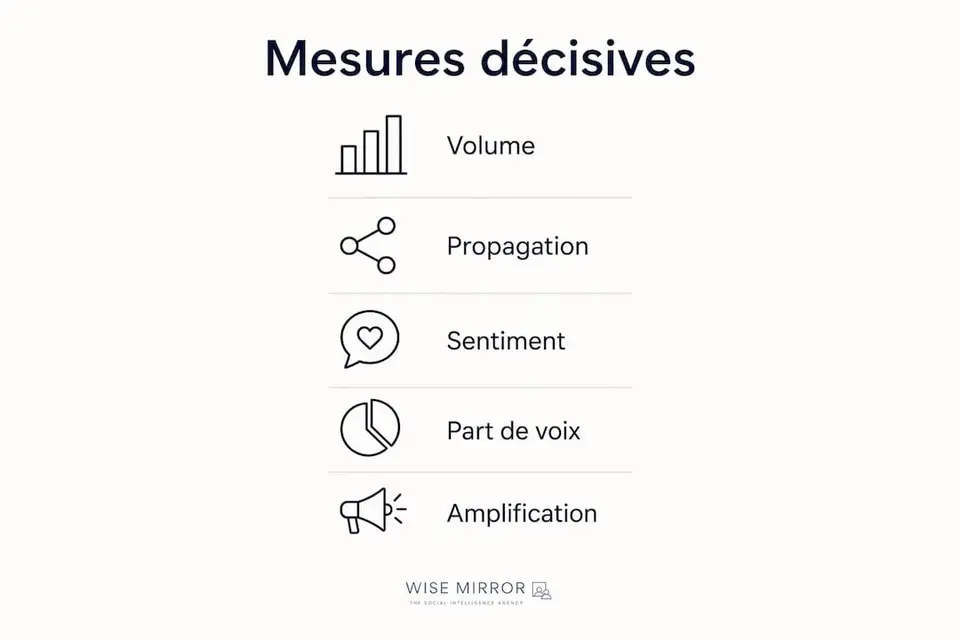
| Metric | Definition | Alert threshold | Decision-making use |
|---|---|---|---|
| Hourly volume | Number of mentions per hour | +30% in 24 hours | Detecting sudden shifts |
| Spread velocity | Shares and reposts per hour | Doubling in 6 hours | Assessing virality |
| Weighted sentiment | Negative/positive/neutral score weighted by reach | High negative sentiment | Determining the response |
| Share of voice | % of mentions on the topic vs. competitors | Notable decline | Relative positioning |
| Amplification rate | Ratio of reposts to original posts | > 3× the average | Crisis risk |
For qualitative analysis, influence network analysis (SNA), combined with natural language understanding (NLU), helps identify the actors spreading a narrative and emerging themes before they reach traditional media. This is where weak signals are detected.
How can you integrate social listening into governance?
Roles to define from the outset:
- Steering committee (leadership): validates alert thresholds and makes communications decisions.
- Monitoring team (analysts): collects, cleans, analyzes, and produces recommendations.
- Crisis team (operational): can be activated within 2 hours of a critical alert.
- Legal/compliance liaison: checks each protocol against CNIL requirements.
Six-step process:
- Automated collection through platform APIs.
- Cleaning and deduplication (filtering bots, spam, and off-topic content).
- NLU and SNA analysis to assess signals.
- Formal recommendation with a priority level.
- Decision approved by the steering committee.
- Public communications coordinated with the legal team.
Integration timeline: an initial audit takes 4–6 weeks. Setting up the dashboard requires an additional 1–2 months. The executive reporting routine (weekly under normal conditions, daily during critical periods) is established within 3 months. When using social data in strategic decision-making, gradual integration is more reliable than a large-scale rollout.
Indicative cost model: a one-off audit generally costs between €3,000 and €15,000, depending on its depth. An annual monitoring subscription varies according to coverage and level of analysis. A crisis management package available for activation around the clock is contracted separately, with fees tailored to the incident’s duration and complexity.
How can you detect weak signals and manage a digital crisis?
Early detection relies on monitoring sudden shifts, not absolute levels. An issue that doubles in volume within six hours among a usually quiet audience segment deserves more attention than a predictable spike linked to a scheduled event.
Four-step detection protocol:
- Monitor breaks in trends: deviations greater than twice the usual standard deviation over 24 hours.
- Identify emerging clusters of actors: new influential accounts entering the conversation.
- Correlate with offline events: a court ruling, a report’s publication, or an on-the-ground incident.
- Calculate an impact score = volume × velocity × source credibility × estimated public exposure.
Pro tip: Run a quarterly simulation exercise. Trigger a mock alert internally and measure the response time at every link in the chain. Weaknesses always appear where you least expect them.
For your institutional crisis protocol, prepare preapproved messages for each severity level, designate a single spokesperson, and define the legal escalation threshold before a crisis occurs. Executive communications during a digital crisis follow different rules from standard institutional communications.
What legal framework applies in France?
Council of State decision No. 499924 (March 26, 2025) establishes a clear legal distinction: institutional accounts (in French) contribute to a public service mission and are subject to a heightened obligation of neutrality, particularly during election periods. Elected officials’ personal accounts fall under a different framework.
Practical obligations:
- Document the methodology for collecting and analyzing social data.
- Limit data retention periods in accordance with CNIL requirements.
- Anonymize personal data before any analytical processing.
- Systematically coordinate communications and legal teams before taking any public position.
Do not confuse an operational response with a political position. An institutional account can provide information about a crisis; it cannot take sides on an electoral issue. Institutional trust in the digital age rests precisely on this dividing line.
Should you bring social monitoring in-house or outsource it?
| Criterion | In-house capability | Agency support |
|---|---|---|
| Initial cost | High (recruitment, licenses) | Controlled (fixed fee or subscription) |
| Deployment time | 3–6 months | 4–8 weeks |
| Depth of analysis | Varies with available skills | Immediate senior expertise |
| 24/7 continuity | Difficult without a dedicated team | Included in specialized offerings |
Key skills to hire or contract: a senior social listening analyst, an NLU-specialist data scientist, an SNA analyst for influence mapping, a legal specialist in CNIL requirements, and an operational communications manager.
The ZANNI platform, offered by Wise-mirror, illustrates what an activation ecosystem can deliver: optimized content production, coordinated distribution, and performance tracking in a compliant environment. For organizations getting started, the recommendation is to begin with an external audit before considering a gradual move in-house. Political engagement through social media follows community activation principles that few internal teams master from the outset.
Key takeaways
Social media primarily influences the public agenda: structured listening with alert thresholds and clear governance is the most effective operational response for decision-makers in France.
| Point | Details |
|---|---|
| Agenda setting, not direct manipulation | Platforms change public priorities, rather than automatically changing individual opinions. |
| Five executive metrics | Volume, velocity, sentiment, share of voice, amplification: the minimum actionable dashboard. |
| Operational alert threshold | A 30% increase in volume over 24 hours combined with negative sentiment > 40% triggers an immediate review. |
| CNIL compliance is nonnegotiable | Document the methodology, anonymize data, and limit retention before any deployment. |
| Wise-mirror + ZANNI | Initial audit, 24/7 monitoring, and activation through ZANNI: the shortest path from listening to decision-making. |
What research still does not explain clearly enough
The debate about social media’s impact on public decisions suffers from a persistent framing bias: we look for dramatic effects (radicalization, electoral manipulation) and miss the central issue. The real effect is subtler and more dangerous for institutions: a slow shift in perceived priorities that accumulates without any identifiable triggering event.
What organizations consistently underestimate is the persistence of algorithmic effects after deactivation. An organization that suspends monitoring for six months does not return to a blank slate: its audiences’ information environment has continued to evolve without it. Resuming listening after a break requires a catch-up audit, not simply reactivating the dashboard.
The other blind spot is the gap between the teams producing monitoring data and those making decisions. The best metrics in the world have no impact if they land in an inbox nobody reads before Friday’s meeting. Governance, not technology, is the real limiting factor.
Wise-mirror supports you from listening to decision-making
You have the metrics, the thresholds, and the legal framework. What is often missing is the ability to turn all of this into an operational recommendation within 48 hours. That is exactly what Wise-mirror does for public and private organizations in France: a reputation audit to establish your baseline, continuous monitoring with senior analysts and AI to ensure nothing is missed, crisis management available for activation around the clock, and activation through the ZANNI platform to move from signal to action.

CNIL compliance is built into every engagement from the outset. You do not have to choose between responsiveness and legal rigor. Request your initial audit or a demonstration at wise-mirror.fr and receive an initial assessment of your digital exposure within two weeks.
Sources and recommended reading
- CEVIPOF — Political Effects of Social Media (May 2024): a reference empirical study on political behavior and platform use in France.
- CEVIPOF — Social Media Does Not Make Politics (November 2025): analysis of differentiated usage and the absence of a uniform effect on political perceptions.
- Constitutional Council — Social Media and the Reconstruction of Politics: an institutional foundation for governing digital public spaces.
- DBS Avocats — Council of State Decision No. 499924 (March 2025): legal analysis of the distinction between institutional accounts and elected officials’ personal accounts.
- CEPR / VoxEU — Algorithmic Effects on Political Attitudes: a large-scale experiment on the persistent effects of recommendation algorithms.
- Wise-mirror — Blog and methodological resources: SNA, NLU, and metrics best practices for decision-oriented monitoring.
Frequently asked questions
Does social media really change public decisions?
It primarily changes perceived priorities and the political agenda, rather than directly changing individual opinions. The effect is cumulative and context-dependent, as confirmed by CEVIPOF and CEPR research.
Which indicators should you monitor first?
Hourly volume, spread velocity, weighted sentiment, share of voice, and amplification rate form the minimum dashboard for any decision-maker.
Is social monitoring compatible with the GDPR and CNIL requirements?
Yes, provided the methodology is documented, personal data is anonymized, and retention periods are limited. Wise-mirror incorporates these requirements into every engagement.
Is it better to bring social monitoring in-house or outsource it?
For most organizations, starting with an external audit (4–8 weeks for deployment) is faster and less expensive than hiring in-house. A gradual move in-house can then be considered based on needs.
What is the ZANNI platform offered by Wise-mirror?
ZANNI is Wise-mirror’s activation ecosystem: it enables the transition from signal analysis to the production and distribution of optimized content, in an environment compliant with French legal requirements.