Digital Competitor Monitoring: 2026 Industry Guide

The French digital market (in French) is expected to reach €74.3 billion in 2026, representing growth of 4.3%. While impressive on the surface, this figure conceals a far more complex reality for marketing and communications leaders: the volume of industry information to monitor is expanding as rapidly as the sector itself. Digital competitor monitoring is no longer a convenient option reserved for major corporate strategy departments. It has become a survival skill for anyone managing a brand's image in an environment where a competitor can change its positioning within 48 hours.
Table of Contents
- The fundamentals of digital competitor monitoring
- Legal and ethical challenges for digital monitoring in 2026
- Adopting artificial intelligence to improve competitive intelligence
- How to build effective and agile digital industry monitoring
- Best practices and advanced tips for digital competitive intelligence
- Rethinking digital competitor monitoring in 2026
- Optimize your monitoring and social intelligence with Wise Mirror
- Frequently asked questions
Key Takeaways
| Point | Details |
|---|---|
| The importance of structured monitoring | Well-organized digital industry monitoring helps you anticipate market and competitor developments effectively. |
| Respect the legal framework | The GDPR and AI Act impose requirements that all digital monitoring must strictly follow. |
| Use AI to improve efficiency | Artificial intelligence simplifies large-scale data collection and analysis, accelerating decision-making. |
| Act in real time | Detecting and responding immediately to competitive changes maximizes the strategic value of monitoring. |
| Advanced approaches and automation | Custom scripts and competitive SEO are powerful, underused ways to optimize digital monitoring. |
The fundamentals of digital competitor monitoring
Managing this complexity starts with establishing clear foundations. Digital competitor monitoring encompasses the practices used to collect, process, and analyze public information about organizations in a given industry across digital channels. It is not industrial intelligence. It is not espionage. It is systematic online competitive intelligence based on open, legal sources.
The distinction between OSINT monitoring (Open Source Intelligence, meaning intelligence gathered from open sources) and industrial espionage is crucial. OSINT uses only publicly accessible information: websites, social media, press releases, job postings, and patent filings. Industrial espionage, by contrast, involves accessing confidential information through illegal means. For marketing leaders, the boundary is simple: if you have to bypass secure access to obtain information, you have crossed the line.
Basic digital market analysis tools available to organizations of all sizes include:
- Google Alerts: automated monitoring of competitor brand mentions and industry keywords
- LinkedIn: tracking recruitment, leadership changes, and new strategic publications
- SEMrush or equivalent tools: tracking SEO rankings and competitors' content strategies
- Public databases (INPI, the commercial register, Bodacc): detecting changes in ownership and capital structure
- Social listening platforms: real-time analysis of conversations about an industry
Resource requirements are often underestimated. Structured monitoring for an SME (in French) requires between 2 and 4 hours per week, while a large company with numerous competitors should dedicate a full-time employee to it. This framework helps you size the investment before implementing annual strategic monitoring or commissioning an online reputation audit.
Legal and ethical challenges for digital monitoring in 2026
Beyond practical considerations, digital industry monitoring operates within a strict legal framework that must be respected. And that framework is tightening in Europe.
The GDPR has regulated personal data collection since 2018. But the AI Act, which has gradually come into force since 2024, adds another layer: algorithms used to monitor and analyze data must now meet stricter audit requirements (in French) and compliance obligations, particularly regarding transparency in how they work and the prevention of discriminatory bias.
What this means in practice for your monitoring activities:
- Any automated data collection involving identifiable individuals must comply with 2025 GDPR requirements (in French)
- Sentiment analysis algorithms or profiling tools fall within the scope of the AI Act if their impact is considered significant
- The third-party tools you use must be able to demonstrate compliance, not just your own organization
- Documenting your monitoring processes provides legal protection in the event of a dispute
Regulatory compliance is not a barrier to competitive intelligence. Properly integrated, it provides a framework that protects you and strengthens the credibility of your internal analyses.
A professionally conducted online reputation audit must therefore incorporate these requirements from the outset, rather than address them after the fact. Digital competitive risks now include both market players' moves and penalties for noncompliance in your own monitoring tools.
Adopting artificial intelligence to improve competitive intelligence
One key technological response to these challenges is the growing adoption of artificial intelligence in competitor monitoring. The figures speak for themselves: 75% of marketing organizations (in French) now use generative AI, a widespread adoption that reflects increasing pressure for faster, more personalized analysis.
In practical terms, AI is transforming online competitive intelligence in three main ways:
- Automated collection: AI agents continuously scan thousands of sources, from industry forums to RSS news feeds, without daily human intervention
- Advanced semantic analysis: natural language processing detects weak signals, such as a change in the tone of a competitor's communications or the emergence of a new brand narrative
- Synthesis and prioritization: rather than overwhelming teams with raw data, AI models generate actionable summaries and rank alerts by urgency
However, significant challenges remain. The relevance of the output depends entirely on the quality of the input data. A model trained on insufficient industry data will produce biased analyses. Confidentiality also raises concerns: sending sensitive data to third-party AI platforms can create legal risks if those platforms are not GDPR-compliant.
Pro tip: before integrating an AI tool into your digital competitive strategies, always ask where the processed data is hosted and whether the provider is certified as compliant with European law. This simple question eliminates most risks upfront. The social listening agency you choose should be able to answer it without hesitation.
How to build effective and agile digital industry monitoring
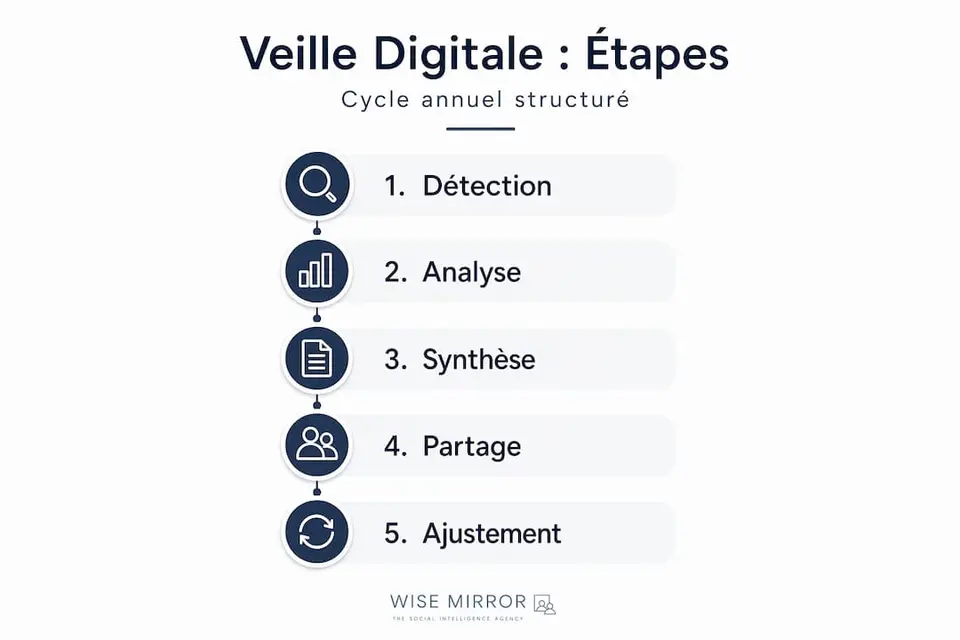
To take full advantage of AI and digital tools, it is essential to organize your digital industry monitoring appropriately. The value of competitive intelligence is highest on the day a change is detected. This means organization matters as much as the tools.
Here is a proven operational structure:
- Define your monitoring objectives before choosing your tools. What exactly are you looking to do: anticipate product launches, monitor public statements, or detect shifts in market share?
- Map your competitors in three circles: direct competitors (same offering, same audience), indirect competitors (alternative offering), and potential entrants (industry startups and foreign players expanding into the market)
- Schedule an in-depth monthly review alongside a brief weekly alert on key events
- Centralize data in a shared tool accessible to your marketing, communications, and executive teams
- Integrate findings into monthly strategy meetings, with a summary of no more than two pages
Pro tip: the reporting format is often what undermines good monitoring. A 40-page report that nobody reads is worth less than a three-point alert read by the entire executive committee. Put as much care into presentation as you do into collection.
| Frequency | Type of action | Estimated time | Deliverable |
|---|---|---|---|
| Daily | Scan Google Alerts and social media | 15 to 20 minutes | None unless an urgent alert is needed |
| Weekly | Summarize significant signals | 1 to 2 hours | Brief internal memo |
| Monthly | In-depth industry analysis | 4 to 6 hours | Summary report |
| Quarterly | Review objectives and metrics | 2 hours | Updated monitoring framework |
Annual strategic monitoring structured around this framework establishes a regular cadence, while tailored social intelligence services help scale this discipline without committing disproportionate resources.
Best practices and advanced tips for digital competitive intelligence
Beyond the fundamentals and organizational structure, certain advanced practices make all the difference to effective digital monitoring.
The first is automation through AI scripts. Custom API-based scripts can monitor hundreds of competitors at low cost and detect changes that conventional tools miss. One solo founder automatically mapped 190 competitors by combining API calls to language models with industry RSS feeds. What was once reserved for large companies with dedicated teams is becoming accessible to midsize organizations with some technical expertise.
The second advanced practice involves competitive SEO through semantic content clusters. Targeting a competitor's brand (in French) through semantically related content helps attract prospects who are actively researching, before they make a purchasing decision. It is legal, ethical, and remarkably effective when your competitor has strong brand awareness but a weak content strategy.
The third involves LinkedIn as a priority OSINT source. LinkedIn reveals strategic changes well before official announcements: a surge in AI engineer recruitment signals a technological pivot, while a wave of departures from the marketing team often indicates an imminent repositioning. These early, free, public signals are consistently underused.
| Method | Cost | Complexity | Detection time |
|---|---|---|---|
| Manual Google Alerts review | Free | Low | 24 to 48 hours |
| SaaS social listening tool | Medium to high | Low | Real time |
| Custom AI scripts | Low to medium | High | Real time |
| Manual LinkedIn monitoring | Free | Medium | 1 to 7 days |
| Specialist agency | High | None | Real time with analysis |
Pro tip: the most effective digital solutions for businesses (in French) for monitoring competitors always combine two layers: automated tools for broad coverage and human analysts to interpret ambiguous signals. One without the other produces either noise or blind spots. Wise Mirror's monitoring expertise is built precisely on this complementary approach.
Rethinking digital competitor monitoring in 2026
These practices invite us to rethink digital competitor monitoring beyond tools, taking a deeper and more responsible view.
The uncomfortable truth that few articles dare to state: most organizations practice monitoring for reassurance. They collect information, produce reports, and store those reports in shared folders that nobody opens until the next crisis. The value of competitive intelligence deteriorates quickly if it is not used in real time. This is not a tools problem. It is an organizational culture problem.
The second major paradox of 2026 is regulation as a competitive advantage. Yes, the AI Act and GDPR create real constraints. But European legal clarity can become a strategic asset: organizations that have a firm grasp of compliance can highlight this transparency to partners, customers, and investors. Constraints become differentiation.
At Wise Mirror, after supporting dozens of public and private organizations, we have observed that the teams getting the most value from their annual strategic monitoring are those that have turned intelligence gathering into a collective habit. Not just a dedicated function, but a shared mindset across marketing, communications, and leadership. A salesperson who flags a LinkedIn signal during a weekly meeting has more impact than a monthly report sent at 11 p.m.
Effective digital industry monitoring in 2026 is not a question of budget or technology. It is a question of how quickly you move from detecting a signal to making a decision.
Optimize your monitoring and social intelligence with Wise Mirror
Here is how Wise Mirror can help you put these best practices into action and benefit from effective digital industry monitoring.
Wise Mirror combines advanced social intelligence, artificial intelligence, and senior analysts to turn digital conversations into strategic decisions. Our teams decode weak signals, map industry influence, and continuously track changes in your brand image.

Whether you want to establish an initial assessment with a reputation audit, maintain continuous oversight through our annual strategic monitoring, or activate a crisis response team in under 24 hours, our services adapt to your organization's size and challenges. Contact our analysts to define a monitoring framework that matches your industry and objectives.
Frequently asked questions
What is digital competitor monitoring?
It is the regular collection and analysis of public information about competitors in the digital sector to anticipate their actions and adjust your marketing strategy. It relies exclusively on legally accessible sources and is a cornerstone of any proactive communications strategy.
Is OSINT monitoring legal for businesses?
Yes, OSINT monitoring is legal as long as it is limited to public information accessible without bypassing security. It becomes problematic only if it involves private data, unauthorized access, or deceptive practices.
What are the main risks of digital monitoring in Europe?
The main risks concern compliance with the GDPR and the European AI Act, particularly algorithmic transparency and the prevention of discriminatory bias. Third-party monitoring tools must also be compliant, not just your own internal processes.
How does AI improve competitor monitoring?
AI automates collection, rapidly analyzes large volumes of data, and detects weak signals. According to Salesforce's marketing report, 75% of marketing organizations now use generative AI to meet these growing demands for speed and accuracy.
How much time should you spend on effective competitive intelligence?
For an SME, 2 to 4 hours per week is sufficient with a structured approach, while large companies with several direct competitors need to dedicate a full-time employee to maintain comprehensive, responsive coverage.