Digital Crisis Management for Institutions: 2026 Guide

At a glance:
- Digital crisis management rapidly coordinates responses to digital threats spreading across social networks and online media. It involves a multidisciplinary crisis team, strict protocols, and transparent communication from the first hour. Regulations require tested plans, regular exercises, and specific vigilance against synthetic content and deepfakes.
Digital crisis management for institutions refers to an organization's ability to orchestrate a coordinated, rapid, and transparent response to a crisis that emerges or escalates online. Industry professionals also use terms such as “online crisis management” or “digital crisis response.” Both describe the same reality: a threat that spreads within minutes across social media, online news outlets, and messaging platforms, demanding an organized response long before traditional media picks it up. European legislation, including NIS2 and the AI Act, now imposes concrete obligations on organizations to maintain tested, documented plans. Mastering these mechanisms is no longer optional for leaders: it is a condition for institutional survival.
How do you structure an effective digital crisis team?

An effective digital crisis team depends on a multidisciplinary structure. At a minimum, it includes a communications lead, a legal adviser, an operations lead, and, since 2026, an AI monitoring specialist. Each role covers a specific area: communications manages public statements, legal validates commitments, operations coordinates on-the-ground actions, and the AI specialist monitors synthetic content and digital impersonation.
The team's day-to-day operating model determines its actual responsiveness. Short, 20-minute sessions (in French) significantly improve coordination compared with lengthy monthly meetings. This cadence keeps teams alert without exhausting them and allows priorities to be adjusted in real time.
Continuity of governance also depends on the quality of basic tools. The emergency contact directory (in French) must be updated every six months and accessible without an internet connection. A major cyberattack can cut off access to online systems: a paper directory or an encrypted offline copy then becomes the only fallback.
Detecting disinformation and deepfakes presents a new challenge for crisis teams. Incoming information must be systematically verified before any decision or public statement. Validation protocols and clearly defined decision-making chains prevent rushed responses based on falsified information.
- Appoint an AI monitoring specialist dedicated to tracking synthetic content
- Maintain an offline contact directory, updated every six months
- Hold daily 20-minute sessions during an active crisis
- Document every decision with a timestamp for legal traceability
- Establish dual-signature approval protocols for official communications
Pro tip: Create an operational password (in French) shared offline between the executive and the crisis team, and renew it every quarter. This code authenticates critical instructions and protects against deepfake impersonation.
Which institutional communication strategies should you use in a digital crisis?
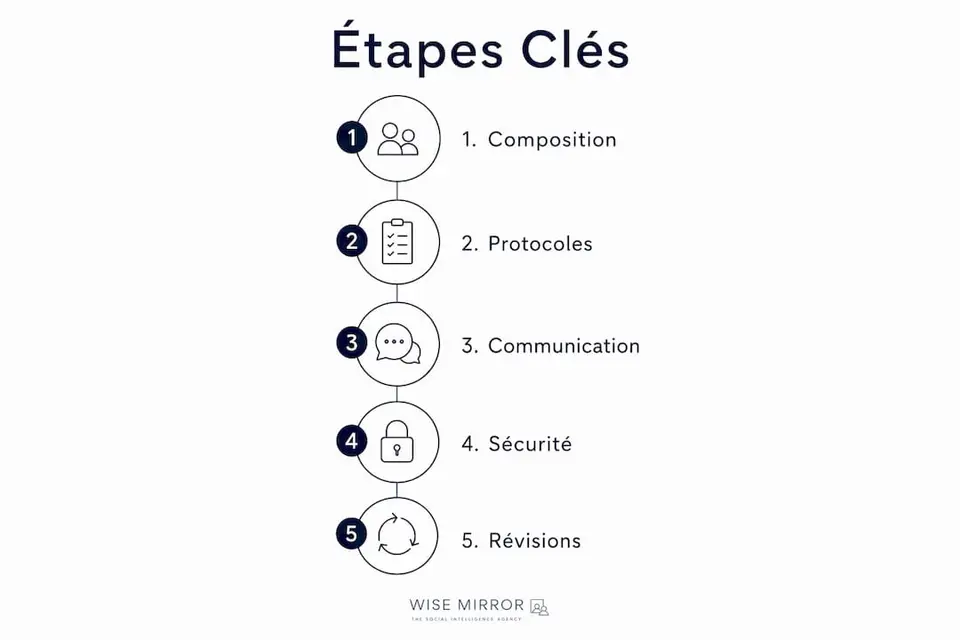
The first hour of a digital crisis (in French) is decisive. A prompt, measured, factual statement frames the discussion before rumors take hold. Silence, however brief, creates a narrative vacuum that others fill on your behalf.
Effective crisis communication rests on five operational principles:
- Speak quickly and accurately. Publish an initial acknowledgment within the first 30 minutes, even without all the facts. State that the situation is being addressed and that a full update will follow.
- Align every channel. The spokesperson, institutional website, social media accounts, and official documents must convey the same message. Any contradiction between channels fuels distrust.
- Coordinate internal functions. Coordination between legal, compliance, operations, and communications ensures accurate, consistent messaging. A message approved solely by communications, without legal review, exposes the organization to commitments it has not properly assessed.
- Counter rumors with evidence. Publish verifiable documents, timestamped screenshots, or quantitative data. Documentary evidence puts an end to speculation.
- Avoid excessive defensive communication. Issuing repeated statements without new information undermines credibility. Fewer, stronger statements are preferable.
Pro tip: Prepare three prewritten message templates for the most likely scenarios: a data breach, an operational incident, and public allegations against an executive. These templates shorten response times without sacrificing quality.
Institutional credibility (in French) no longer rests on hierarchical status. It rests on the ability to inform honestly, correct mistakes without evasion, and avoid silence. Organizations that acknowledge their mistakes publicly and promptly emerge from crises with their reputations intact, or even strengthened.
How do you integrate generative AI threats into crisis management?
Generative AI creates an unprecedented category of threats for institutions. An audio deepfake of an executive can order a fraudulent bank transfer. A synthetic video can trigger a reputation crisis within hours. Such content is now accessible to malicious actors without advanced technical skills.
Generative AI requires new roles within the crisis team, notably an AI monitoring specialist and a legal adviser specializing in the AI Act, DSA, and SREN law. These two specialists work in tandem: the first detects suspicious content, while the second assesses available legal remedies.
Strong authentication measures are becoming nonnegotiable:
- Establish an offline operational code word, renewed quarterly, to validate high-stakes instructions
- Apply the four-eyes + 24-hour principle: every sensitive instruction must be approved by a second manager after a cooling-off period
- Systematically verify the origin of any video or audio content before sharing it internally or externally
- Document impersonation attempts to build an actionable legal case
“The deepfake threat cannot be managed with tools alone. It requires rigorous human protocols, a culture of verification, and specialists trained to recognize warning signs. Organizations that rely solely on automated detection technology underestimate the sophistication of today's attacks.”
The European regulatory framework is evolving rapidly. The AI Act imposes transparency obligations on AI-generated content. The DSA (Digital Services Act) strengthens platforms' responsibility for moderating synthetic content. The SREN law (Securing and Regulating the Digital Space) adds specific obligations for French organizations. Your legal adviser must understand all three laws to advise the crisis team in real time.
Exercises and risk culture: how do you build resilience?
Resilience to digital crises is built before a crisis, not during it. The organizations that handle incidents best are those that have prepared methodically, with regular exercises and structured reviews of lessons learned.
An annual minimum schedule (in French), alternating tabletop exercises with full-scale simulations incorporating field operations, maintains team proficiency. Tabletop exercises test decision-making protocols without mobilizing every resource. Full-scale simulations reproduce real conditions of stress, conflicting information flows, and time pressure.
| Exercise type | Recommended frequency | Main objective |
|---|---|---|
| Tabletop exercise | Twice a year | Test protocols and decision-making chains |
| Full-scale simulation | Once a year | Reproduce real crisis conditions |
| Deepfake inject | At least once a year | Train teams to detect synthetic content |
| After-action review workshop | After every exercise | Build constructively on lessons learned |
Including at least one annual exercise with a deepfake inject effectively trains teams to identify and manage generative AI threats. This specific exercise creates a collective memory: teams that have already “experienced” a deepfake attempt respond faster and more accurately to a real threat.
The after-action review (in French) must take a nonpunitive approach, combining individual interviews with group workshops. The goal is to produce concrete, measurable, achievable action plans. A punitive review encourages people to conceal mistakes. A constructive review promotes learning.
Pro tip: Appoint an external facilitator to lead post-exercise reviews. An outside perspective ensures neutrality and encourages participants to speak freely, particularly about problems within the management hierarchy.
Crisis management is a continuous cycle: every review informs prevention and becomes embedded in organizational culture. Organizations that treat crises as exceptional events remain vulnerable. Those that integrate crisis management into their normal operations build lasting resilience.
How does digital crisis management connect to regulatory obligations?
Regulatory obligations for crisis management have strengthened considerably since 2023. Four laws now shape the legal framework for French and European organizations.
| Regulation | Scope | Main obligation | Maximum penalty |
|---|---|---|---|
| NIS2 | ~15,000 French entities | Tested and documented crisis plan | €10 million or 2% of revenue |
| DORA | Financial sector | Operational resilience testing | Varies by national authority |
| AI Act | High-risk AI systems | Transparency and traceability | €30 million or 6% of revenue |
| DSA | Digital platforms | Content moderation and reporting | 6% of global revenue |
The NIS2 Directive requires approximately 15,000 French entities to maintain a regularly tested crisis management plan. Financial penalties for noncompliance reach €10 million or 2% of revenue. These amounts turn crisis management from an optional investment into a governance obligation.
The CER (Critical Entities Resilience) Directive complements NIS2 by covering physical and digital infrastructure in essential sectors. DORA requires the financial sector to conduct documented operational resilience tests. These laws converge on the same requirement: demonstrating, through traceable exercises, that your organization can manage a crisis.
Regulatory monitoring is therefore becoming an integral part of digital crisis prevention. A legislative change can alter your notification obligations, response deadlines, or documentation requirements. Your legal adviser must monitor these developments continuously, not just during annual plan reviews.
Key takeaways
Digital crisis management for institutions requires a multidisciplinary team operating under precise protocols, transparent communication from the first hour, and regular exercises incorporating generative AI threats.
| Point | Details |
|---|---|
| Multidisciplinary team | Include an AI monitoring specialist and a legal adviser specializing in the AI Act, DSA, and SREN. |
| Decisive first hour | Publish an initial factual message within 30 minutes to frame the discussion before rumors spread. |
| Anti-deepfake authentication | Use an offline code word renewed quarterly and the four-eyes + 24-hour principle. |
| Targeted annual exercises | Alternate full-scale simulations and deepfake injects to maintain team proficiency. |
| Regulatory compliance | NIS2, DORA, the AI Act, and the DSA require tested, documented plans, with heavy penalties for noncompliance. |
What years of observing institutional crises have taught me
Most organizations I have seen go through a digital crisis had a plan. The problem was not the absence of a document. It was the absence of practice. The plan sat in a drawer, the contacts were outdated, and no one had ever simulated the real pressure of a live crisis.
What I consistently observe is that leaders underestimate the courage transparency requires. Publicly admitting a mistake, correcting false information released by their own communications department, responding to viral allegations without hiding behind a legally watertight but emotionally empty statement. It is difficult. Yet that is exactly what audiences expect today.
Generative AI has changed the game in one specific area: trust in sources. Previously, a video of an executive was evidence. Today, it is a hypothesis to verify. Organizations that have not yet incorporated this reality into their protocols are operating with a gaping vulnerability. I have seen crisis teams paralyzed for 40 minutes because no one knew whether the audio circulating was authentic or synthetic. Forty minutes in a digital crisis is an eternity.
My most practical advice: invest in crisis management training before investing in tools. A deepfake detection tool without a team trained to interpret its results protects no one. A trained team with basic tools remains operational. The reverse is not true.
— GB
Wise-mirror: detect signals before a crisis breaks

Wise-mirror helps public and private organizations continuously monitor their digital environment. The platform combines social listening, reputation analysis, and weak-signal detection to alert teams before an incident becomes a crisis. Wise-mirror's senior analysts interpret societal trends, map influence ecosystems, and provide a clear understanding of online conversations. For crisis teams, this real-time social listening offers a decisive advantage: acting on verified data rather than rumors. Wise-mirror also offers a strategic alert service that can be activated around the clock for emergencies.
Frequently asked questions
What is digital crisis management for institutions?
Digital crisis management for institutions encompasses the methods and protocols an organization activates to respond to a crisis that emerges or escalates online. It covers detection, communication, internal coordination, and regulatory compliance.
Which roles are essential in a digital crisis team?
A digital crisis team must include a communications lead, a legal adviser, an operations lead, and, since 2026, an AI monitoring specialist with expertise in synthetic-content threats and the AI Act, DSA, and SREN regulations.
How can you protect against deepfakes during a crisis?
Protection rests on two complementary measures: an offline operational code word renewed quarterly, and the four-eyes + 24-hour principle, which requires dual approval for any high-stakes instruction before execution.
Which regulations require a tested crisis management plan?
The NIS2 Directive requires approximately 15,000 French entities to maintain a regularly tested plan, with penalties reaching €10 million or 2% of revenue. DORA, the AI Act, and the DSA add specific obligations depending on the sector.
How often should you run crisis management exercises?
An annual minimum schedule is recommended, alternating tabletop exercises with full-scale simulations. At least one exercise per year must include a deepfake inject to train teams to identify and manage generative AI threats.