Crisis Management Budget: How Much to Set Aside in 2026
For an SME, set aside a dedicated annual reserve covering monitoring, a crisis response team, and content production, with three top priorities: continuous mention monitoring, a team capable of responding in under 24 hours, and rapid content production to regain control of the narrative. Include a CNIL compliance line item from the outset: it prevents unwelcome surprises when a crisis involves personal data.
At a glance:
- Budget planning should include an annual reserve for monitoring, crisis management, and content production, with particular attention to CNIL compliance.
- A crisis team's ability to respond in under 24 hours often matters more than the size of the allocated budget.
- For a data breach crisis, budget for a compliance audit, legal advice, and technical measures during the prevention phase.
- Costs vary considerably depending on the incident, the organization's size, and the crisis duration, with additional resources required for prolonged crises or those involving legal issues.
- Budget modeling should follow a structured method, incorporating likely scenarios, associated costs, and emergency reserves, with an annual review recommended.
Table of contents
- Budget breakdown: monitoring, response team, content, activation, and legal support
- Cost examples by organization size and crisis scenario
- Building the budget: audit, scenarios, modeling, and KPIs
- In-house or agency: operational and financial criteria
- French regulatory requirements and compliance costs to budget for
- Recurring costs and subscription models (monitoring and activation)
- Budget checklist and line-item template for committee review
- Wise Mirror's practical perspective: lessons learned and pitfalls to avoid
- How Wise Mirror helps plan and manage your crisis management budget
- Sources
- Frequently asked questions
Budget breakdown: monitoring, response team, content, activation, and legal support
A crisis management budget separates two activities: prevention, which runs year-round, and response, which is activated only when an incident occurs. This distinction changes the nature of the costs: prevention relies on subscriptions and analyst hours, while response involves emergency fees and sometimes media buying to amplify a corrective message.
Organizations that budget seriously for crisis management generally divide their spending across these functions:
- Continuous monitoring: real-time dashboards and regular reports, often the most stable expense throughout the year.
- Crisis response team: availability and coordination during the incident, billed through fees or a fixed intervention package.
- Content production: copywriting, visuals, and corrective messages, with costs rising sharply during the acute phase.
- Activation and distribution: distributing content across relevant channels, potentially including media buying.
- Legal advice and compliance: GDPR checks and CNIL notification if personal data is involved.
In practice, monitoring represents the most predictable share of the budget because it is contracted in advance.
Cost examples by organization size and crisis scenario
Three scenarios occur most frequently and call for very different budgets.
- Social media backlash: an SME may get through it with a few thousand euros for content production and a short-term team intervention over two or three days. A mid-sized company, with more channels to monitor, generally spends tens of thousands of euros over the course of the incident.
- Personal data breach: this scenario systematically adds a legal component and CNIL notification, increasing the budget to cover a compliance audit and specialist advice, on top of crisis communications themselves.
- Executive-related crisis: often the most damaging to reputation, it requires a rapid, coordinated response, with the team mobilized for several weeks and a larger volume of content than for a typical social media backlash.
For each scenario, plan a low range (an incident contained within a few days), a medium range (one to two weeks of mobilization), and a high range (a prolonged crisis with a legal component). A large company with multiple brands or subsidiaries should multiply these amounts by the number of exposed entities rather than work through individual line items. In every case, mobilization speed matters as much as the amount: a team capable of responding within 24 hours often limits damage more effectively than a larger budget that takes longer to release.
Building the budget: audit, scenarios, modeling, and KPIs
A simple method that can be applied across organizations consists of four steps.
- Initial audit: map your current exposure (mentions, sentiment, sensitive channels) before estimating any costs.
- Crisis scenarios: list the two or three most likely incidents for your sector and estimate their average duration.
- Cost modeling: assign monitoring, response team, and production costs to each scenario, then add them together.
- Emergency reserve: add an unallocated buffer that can be accessed without a lengthy budget approval process.
The digital success metrics described in this guide to project metrics (in French) provide a useful framework for choosing your own crisis management KPIs: average response time, volume of negative mentions addressed, and cost per day of team mobilization. These metrics also help justify the budget to a committee, line by line, rather than as a single total.
Pro tip: review your crisis management budget at least twice a year, not just after an incident: activation thresholds quickly become outdated as channels evolve.
In-house or agency: operational and financial criteria
The choice between an internal team and a specialist agency depends primarily on three criteria: the organization's digital maturity, how critical its reputation is, and how frequently incidents occur. A company dealing with social media backlash once a quarter generally benefits from an external framework agreement rather than maintaining expensive internal on-call coverage year-round.
- Training and skills maintenance: an internal team needs regular training, which represents an often underestimated recurring cost.
- On-call coverage and turnover: ensuring 24-hour internal availability requires rotating shifts, with a risk of turnover in the most exposed roles.
- Mobilization speed: an agency with an existing framework agreement can often assemble a response team faster than an internal team that needs to reorganize its schedule.
Outsourcing becomes particularly relevant when a crisis goes beyond communications alone and requires continuous coordination, as detailed in this analysis of marketing outsourcing for SMEs. Conversely, an organization with a mature digital team and infrequent incidents can handle crisis management internally without major additional costs.
French regulatory requirements and compliance costs to budget for
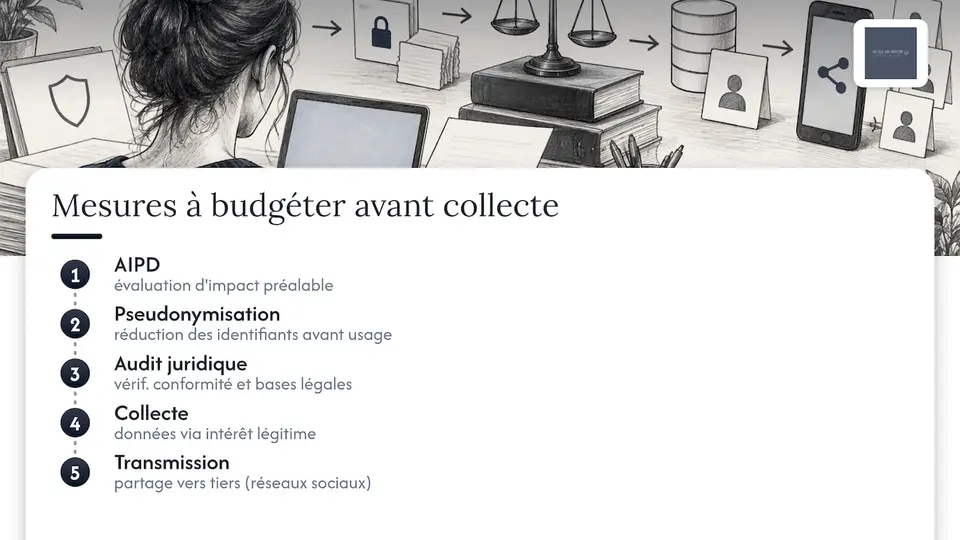
Data collection for monitoring often relies on legitimate interests, a legal basis that the CNIL strictly regulates (in French): it requires compensating safeguards and an assessment of potential impacts on individuals' rights.
The CNIL imposed a substantial financial penalty for the noncompliant transfer of data to a social network to underscore the importance of compliance: a reminder that the compliance line item (DPIA, pseudonymization, legal audit) must be budgeted before an incident, not after.
Recurring costs and subscription models (monitoring and activation)
The cost of managing a crisis on an emergency basis almost always exceeds that of continuous prevention. An annual monitoring subscription, combined with permanent activation capability, reduces the scale of incidents by detecting them early, before they gain momentum on social media.
The model most commonly used by well-structured organizations combines:
- an initial audit to map exposure and set alert thresholds,
- a monitoring subscription for continuous detection of weak signals,
- pre-negotiated intervention credits to mobilize a team without contractual delays when a crisis occurs.
This approach turns unpredictable spending into a stable budget line, making it much easier to present to the executive committee. It also limits the risk of a minor crisis becoming a major one because it was not spotted in time.
Budget checklist and line-item template for committee review
To present a defensible budget to a committee, seven line items generally cover the full scope.
- Initial reputation audit: a one-time expense justified by the current level of exposure.
- Continuous monitoring: an annual expense justified by the volume of mentions tracked.
- Crisis response team: a reserve line justified by the guaranteed response time.
- Content production: a variable expense justified by the volume of corrective messages produced.
- Activation and distribution: a line item linked to campaigns to regain control of the narrative.
- Legal advice and compliance: a fixed line item justified by CNIL obligations.
- Emergency reserve: recommended at around 10–15% of the total budget, accessible without a lengthy approval process.
Linking each line item to a simple metric rather than a raw amount makes committee approval easier.
Wise Mirror's practical perspective: lessons learned and pitfalls to avoid
The most common mistake remains dipping into the regular communications budget when a crisis hits. A dedicated reserve backed by a framework agreement costs less than improvising, even for an SME.
— Nicolas Fabre
How Wise Mirror helps plan and manage your crisis management budget
Building this budget alone takes time and assumes you already know your level of exposure, something few organizations measure internally. The process follows three steps: audit current visibility and reputation, monitor continuously with dashboards and a team assembled within 24 hours, then activate narrative recovery through rapidly produced content distributed on a dedicated platform.
- Audit: an initial assessment to map your exposure before estimating any costs.
- Monitoring: continuous monitoring with a daily update during a crisis.
- Activation: content production and multichannel distribution to regain control of the narrative.
This approach also suits the smaller budgets of SMEs without sacrificing response speed. To assess your current exposure or establish a crisis response team, visit Wise Mirror's services pages or explore our social intelligence offerings directly.
Sources
- Legitimate interests: how can processing rely on this legal basis? | CNIL (in French)
- Budget (in French)
Frequently asked questions
What minimum budget should a small organization plan for?
An annual reserve generally covers basic monitoring and an initial response team intervention for a small organization. This amount excludes legal costs related to a potential data breach, which are added separately.
Should the budget be separate from routine communications?
Yes, a dedicated crisis management reserve avoids drawing on the regular communications budget at the worst possible time. This is the most common budgeting mistake observed among organizations managing their first serious incident.
What compliance costs should you anticipate for a data breach?
You need to budget for a data protection impact assessment, specialist legal advice, and technical measures such as pseudonymization. The CNIL emphasizes that these compensating safeguards are expected from the point of collection, not just after an incident.
Does the government budget circular apply to private companies?
No, circular no. 6506/SG (in French) aims to streamline communications spending by government bodies, with specific rules for major communications initiatives. Private companies can nevertheless use it as inspiration for structuring their own budget decisions.