Influencer Mapping: A 7-Step Method for Professionals

Follow a seven-step method: objectives and ICP, topics and angles, signal collection, network mapping, AI analysis, multicriteria scoring, then human validation before activation. This sequence turns an influencer directory into an evidence-based shortlist and a concrete activation plan, provided you never skip the human checks that filter out false signals.
At a glance:
- Reliable influencer mapping relies on a seven-step method, including social network analysis, multicriteria scoring, and human validation, without skipping that final step.
- The quality of collected signals depends on their diversity, including cross-mentions, joint appearances, shares, podcasts, and past collaborations, all of which must be systematically cross-checked manually.
- Social network analysis (SNA) identifies influencers’ positions within the network, which is crucial for prioritizing those who connect several communities over those with large but isolated audiences.
- Human review is essential for detecting controversies, contentious mentions, or inconsistencies before engaging an influencer, avoiding those with recent negative signals.
- Outsourcing mapping to a specialist agency can save time, ensure expert validation, and produce actionable deliverables for organizing influencer campaigns.
Table of contents
- Which method should you follow to map influencers?
- Where can you find reliable signals for your mapping?
- How can network analysis help you prioritize influencers?
- Which checklist should you use for brand safety before outreach?
- How do you turn mapping into an activation plan?
- Which resources and expertise support this method?
- What failed mapping projects have in common
- Outsource your mapping to Wise Mirror
- Sources
- Frequently asked questions
Which method should you follow to map influencers?
Reliable mapping relies on a structured seven-step process, recognized as a methodological best practice (in French). Each step produces a specific deliverable, avoiding the classic pitfall: a list of names with no rationale or operational follow-through.
- Objectives and ICP (target influencer profile). Define what you are seeking: awareness, lead generation, or support for a launch. Deliverable: an ICP brief with demographic and topic-based criteria.
- Topics and angles. List the topics and keywords that define your ecosystem. Deliverable: a map of priority topics.
- Signal collection. Gather mentions, interactions, and joint event appearances. Deliverable: a raw table of accounts and signals.
- Network mapping. Build the relationship graph connecting these accounts. Deliverable: an SNA (social network analysis) visualization.
- AI analysis. A tool analyzes tone, recurring topics, and content quality. Deliverable: a relevance score for each profile.
- Multicriteria scoring. Weight audience, authority, engagement, and editorial fit. Deliverable: a consolidated scoring sheet.
- Human validation and activation. An analyst checks the selected profiles and prepares the outreach plan. Deliverable: the final shortlist and activation schedule.
The sequence varies little depending on (in French) the objective, but the scoring weights do change: an awareness campaign will prioritize reach and tonal consistency, while a lead generation initiative will emphasize topical authority and the quality of the actual audience.
Where can you find reliable signals for your mapping?
The quality of a map depends directly on the variety of signals collected. Limiting yourself to mentions on a single network produces an incomplete map that misses connectors operating elsewhere.
- Cross-mentions and citations between accounts and media outlets.
- Joint appearances at events, panel discussions, or webinars.
- Content sharing and reuse between creators.
- Newsletters and podcasts, often overlooked even though they reveal lasting relationships built on trust.
- A history of past collaborations with brands in the sector.
Social platform APIs, social listening tools, and content crawling can automate much of this collection, supplemented by CSV exports for self-reported data. The main limitations remain closed platforms, which hide part of the actual graph, and false positives generated by automated accounts or ironic mentions.
Pro tip: always cross-check an automated signal with a quick manual review of three recent posts. Five minutes is often enough to spot an artificially inflated account.
How can network analysis help you prioritize influencers?
Follower counts say almost nothing about an account’s actual influence. What matters is its position in the graph: is it a connector between several communities, an isolated bridge, or a peripheral node that passes nothing along? Network analysis (SNA) reveals these roles, which are often invisible when you look only at audience statistics.
A multicriteria scoring framework translates this analysis into concrete priorities. It typically combines:
- Audience relevance to your ICP.
- Topical authority, measured by content reuse and citations by peers.
- Engagement quality, not just volume.
- Position within the network (connector, bridge, peripheral node).
- Editorial fit with your brand.
- Brand safety level, assessed using the public track record.
This multicriteria weighting provides a rationale for every selected name, which matters when presenting the shortlist to marketing leadership. In practice, a balanced strategy combines one or two authoritative profiles with several micro-influencers more firmly rooted in niche communities.
Which checklist should you use for brand safety before outreach?
Automated analysis identifies candidates. It does not always detect past controversies or poorly received collaborations, making systematic human review essential before any outreach.
- Check the profile’s commercial collaboration history over the past twelve months.
- Search for public controversies or disputes associated with the account.
- Identify contentious mentions or recurring negative comments on its posts.
- Assess the consistency between the profile’s tone and your brand values.
A warning sign (a public accusation, recent controversial remarks, or a suspicious sudden drop in engagement) should trigger escalation to legal or the crisis management team before any outreach. Perceived alignment between the influencer and the brand remains a major determinant of campaign effectiveness, with authenticity now an almost nonnegotiable criterion (in French).
Pro tip: systematically archive screenshots of any problematic posts you identify. They serve as evidence if the situation deteriorates after the campaign launches.
How do you turn mapping into an activation plan?
A map that stays in a spreadsheet serves no purpose. The shortlist must translate into concrete formats: co-created content with identified connectors, long-form content with authoritative profiles, or live formats with the most engaged micro-influencers.
- Set simple KPIs for each test: engagement rate, qualified reach, attributed conversions.
- Test over a short period, generally a few weeks, before deciding on a broader rollout.
- Structure each activation in four stages: initial outreach, a proposed editorial angle, a small-scale test, then scaling up if the results confirm its value.
- Document each iteration to adjust scoring weights in the next mapping exercise.
Influencer credibility remains positively linked to audiences’ purchase intent, with follower attitudes acting as a mediator, as confirmed by a recent consumer behavior analysis (in French). This relationship supports keeping perceived credibility central to your scoring framework rather than giving in to the temptation of reach alone. To structure the transition from analysis to operational decisions, action plan guides for executives (in French) offer useful templates to adapt to influencer marketing.
Which resources and expertise support this method?
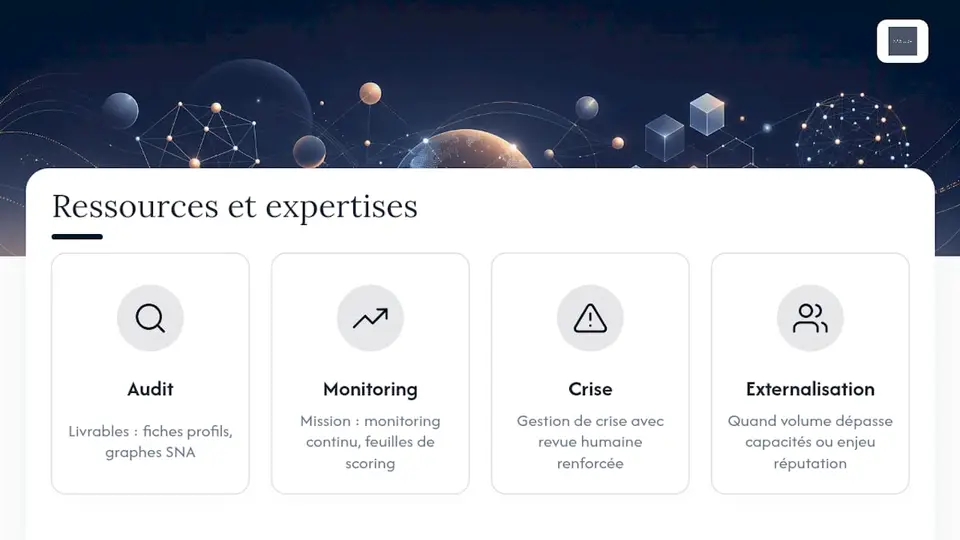
Wise Mirror applies this methodology in its strategic audits, ongoing monitoring, and crisis management engagements, with deliverables comparable to those described here: profile briefs, SNA graphs, and scoring sheets. For a deeper look at each step, the blog offers a detailed guide to mapping a key sector. Outsourcing becomes relevant when the volume of signals exceeds internal capacity or when reputational stakes require more thorough human review.
What failed mapping projects have in common
The most common mistake is optimizing for reach while ignoring the profile’s position within its network. An account with a large audience but isolated from the wider ecosystem often carries less weight than a low-profile connector between several communities. Prioritize signal quality and human review over speed of execution: rushed mapping costs more in repeat outreach than careful scoring from the outset.
— GB
Outsource your mapping to Wise Mirror
Outsourcing is an alternative to building a map in-house when deadlines are tight or the issue affects brand reputation: you can obtain a shortlist validated by senior analysts without tying up an entire team for several weeks.

The agency combines social listening tools, artificial intelligence, and human review to deliver three engagement formats: a one-off strategic audit to map your influence ecosystem, annual monitoring to track its evolution, and crisis management available at any time if a selected profile becomes a risk. Each engagement produces reusable deliverables: network graphs, scoring frameworks, and validation briefs. Explore the offering on the Social Intelligence page and request a scoping discussion for your next mapping project.
Sources
The cited analyses come from Dauphine Eclairages, Cairn, Bastelia, and cBusiness (in French), providing further insight into the method and its implications.
- Influencers: power, controversies, and reinvention — Dauphine (in French)
- The impact of influencers on consumer behavior — Cairn / Vie & Sciences de l’entreprise (in French)
- Identifying B2B influencers through AI-powered social network analysis — Bastelia (in French)
Frequently asked questions
Which techniques are used in influencer mapping?
The approach combines social network analysis (SNA) to identify network positions, automated signal collection through APIs and social listening, then multicriteria scoring validated by human review.
What are the main types of influencers to map?
The common categories distinguish mega-influencers, macro-influencers, micro-influencers, and nano-influencers, classified according to (in French) audience size and their community’s engagement level.
Which tool should you choose to analyze influencers?
There is no universal tool: social listening platforms handle signal collection, while expertise such as Wise Mirror’s adds the AI analysis and human validation needed to make results reliable.
How do you map the risks associated with an influencer?
Check their collaboration history, public controversies, and recent contentious mentions, then escalate to legal or crisis management as soon as a warning sign appears, before making any contact.