LLM Visibility Audit: A Repeatable Framework for Marketing Teams

An LLM visibility audit measures where and how your brand appears in answers from ChatGPT, Perplexity, Gemini, or Copilot, then turns those findings into a prioritized action plan. Typical deliverables combine a quantified baseline, an AI visibility score, and a roadmap. The ultimate goal: gain measurable citations and qualified referral traffic.
At a glance:
- An LLM visibility audit assesses your brand's presence and mentions in generative AI answers from tools such as ChatGPT or Perplexity, focusing on content structure and citing sources.
- The process follows a precise protocol of 10 to 30 representative queries to test multiple models, avoid bias, and assign an overall visibility score.
- Accounting for off-site mentions, particularly on recognized sources, is crucial to strengthening credibility in the eyes of AI systems and improving your presence in their answers.
- Quick actions include structuring content, adding structured data, and correcting entity inconsistencies, with visible impact in 30 to 90 days.
- Regular tracking through automated monitoring and qualitative testing helps anticipate declining AI visibility, particularly during a crisis or algorithm change.
Table of contents
- What is an LLM visibility audit?
- Audit methodology: a step-by-step protocol
- How can you make your content extractable and citable?
- Why do off-site mentions matter as much as content?
- Which KPIs should you track to manage AI visibility?
- Which tools should you use for ongoing visibility testing?
- How should you prioritize actions over 3, 6, and 12 months?
- What results can you expect from an LLM visibility audit?
- Wise Mirror's perspective and field evidence
- The Wise Mirror strategic audit for managing AI visibility
- Further reading
- Sources
- Frequently asked questions
What is an LLM visibility audit?
The technical term for this discipline is Generative Engine Optimization (GEO), sometimes also called LLMO (large language model optimization). Both terms describe the same practice: adapting your online presence so that generative AI systems cite, recommend, or mention you when a user asks a question in your industry.
The difference from traditional search optimization is fundamental. SEO targets a ranking in a list of ten blue links. GEO targets a sentence, a paragraph, or a direct citation within a synthesized answer where you share space with no more than two or three other sources. Search Engine Land's definition of Generative Engine Optimization emphasizes this point: content structure and brand presence where AI systems source their answers matter as much as traditional rankings, if not more.
Why does this change the rules for brand awareness? Because an AI-generated answer acts as an implicit recommendation. A user asking Perplexity “which agency should I use for a reputation audit” does not see ten options to compare, but a shortlist of two or three names. Being absent from that list means disappearing from a discovery channel that already plays a significant role in B2B buying journeys.
An LLM visibility audit is essential in several specific situations:
- Before a product launch or brand repositioning, to establish a benchmark.
- When organic traffic stagnates while informational search volume grows.
- After a reputational crisis, to check what AI systems retain about your brand.
- During a recurring LLM SEO audit, alongside traditional SEO reporting.
This assessment is primarily intended for organizations whose brand, expertise, or reputation directly influences purchasing decisions: consulting firms, software vendors, and consumer brands exposed to reviews.
Audit methodology: a step-by-step protocol
A reproducible audit relies on a rigorous multi-LLM testing protocol, not a few random queries typed into ChatGPT on a Monday morning. Here is the process a thorough LLM assessment follows.
1. Build your prompt sample. Select between 10 and 30 queries representative of your prospects' actual intent: general questions about your product category, implicit comparisons, troubleshooting questions, and requests for recommendations. A multi-LLM audit conducted by Transacts shows that samples of 30 to 80 queries are already sufficient to establish a reproducible baseline and prioritize actions.
2. Choose your target models. Test at least ChatGPT, Perplexity, and Gemini, distinguishing between two technology families: retrieval-augmented generation (RAG) models, which search the web in real time, such as Perplexity or Google's Overviews, and closed models that answer from their training data, such as certain ChatGPT configurations without browsing. This distinction changes everything: a RAG model can cite you as early as tomorrow if you publish the right content, while a closed model will only see that same page during its next training cycle.
3. Collect answers systematically. Run each prompt on each model in private browsing mode and without conversation history to avoid personalization bias. Capture the full answer, transcribe citations verbatim, and record the sources listed or linked.
4. Build and document a score. Assign each prompt a visibility score based on several variables: brand presence or absence, position in the answer (first mention or citation at the end of a list), accuracy of the information provided, and overall sentiment. Add these scores together to obtain an overall AI Visibility Score that can be compared over time.
Pro tip: Document every test with a timestamped screenshot and the exact prompt used. LLM answers vary from one session to another: without traceability, you will never be able to prove an improvement to management six months later.
This protocol turns a subjective impression (“we don't show up in ChatGPT”) into actionable data that can be compared quarter after quarter.
How can you make your content extractable and citable?
An LLM does not read a web page like a human. It breaks content into fragments, or “chunks,” which it evaluates independently to answer a query. A paragraph that needs the three preceding paragraphs to make sense will never be cited, even if the information it contains is excellent.
The chunking rule is to start each section with its answer in one or two self-contained sentences before expanding on it. This practice directly increases the likelihood of extraction, as detailed in the guide LLM SEO: how to be understood and cited by AI. Short paragraphs, a clear heading hierarchy, and one answer per section are better than flowing but tangled prose.
Three technical and editorial levers complement this foundation:
- Schema.org structured data helps engines understand who you are, what you sell, and who speaks on your behalf, strengthening the consistency of your digital entity.
- The llms.txt file, still emerging but closely watched by technical teams, signals the priority areas of your site to AI crawlers.
- Server-side rendering (SSR) remains preferable to fully client-side rendering: content that only appears after JavaScript executes risks remaining invisible to certain extraction bots.
On the editorial side, E-E-A-T remains just as valuable: identify the authors of your content, cite sources for your claims, and quantify your examples. An experiment cited in a reference article on GEO-bench measured that adding citations, quotations, and dated statistics could improve a page's relative visibility by 30 to 40% in the generative answers tested. A dated, sourced figure carries more weight in an LLM's algorithm than a generic claim, however well phrased.
Why do off-site mentions matter as much as content?
LLMs do more than read your website: they weigh what the rest of the web says about you, even when nobody links to you. These unlinked mentions on forums, in news articles, or on community platforms such as Reddit and YouTube are major trust signals, according to Semrush. A model that encounters your name across three independent sources considers you more credible than a brand that only talks about itself on its own website.

The challenge therefore shifts to prioritizing sources. Not all mentions carry equal weight for an LLM: recognized media outlets, academic publications, and Wikipedia inherently carry more weight than generic directories or self-published press releases. A thorough off-site audit starts by mapping where your brand is already mentioned, then identifies high-authority sources where it is still absent.
A second, often overlooked checkpoint is entity consistency. Your company name, business description, and leadership should appear consistently across your website, your Wikipedia page if applicable, your social profiles, and your Google Knowledge Graph. Inconsistencies (different legal names across sources or incorrectly identified executives) fragment the entity signal and dilute your perceived authority.
To take concrete action in this area:
- Launch targeted media outreach to outlets already cited by LLMs for your priority queries, identified during your audit.
- Build content partnerships with authoritative websites in your industry to generate natural co-citations.
- Correct outdated or inconsistent company listings on professional directories and review platforms.
- Encourage organic mentions through expert speaking engagements, interviews, and external contributions.
This work ties directly into brand perception among digital consumers: what the web says about you beyond your direct control now also shapes what AI systems retain.
Which KPIs should you track to manage AI visibility?
Effective management relies on three metric categories, not a single indicator. According to Ahrefs' AI visibility audit (in French), these categories cover visibility, quality, and business impact.
- Visibility: AI share of voice (the proportion of your test prompts where your brand appears) and citation frequency by model.
- Quality: accuracy of the information provided, sentiment associated with your brand, and freshness of the data cited.
- Business: referral traffic from links cited by AI systems and conversions attributable to this channel.
Data collection combines two complementary approaches: regular manual testing of your prompt panel and automated tracking tools such as Google Search Console's generative AI reports or third-party solutions like Semrush AI Visibility. Monthly tracking is sufficient for most brands; weekly tracking is justified during a launch or crisis response.
A basic dashboard tracks these three columns quarter after quarter. What matters is not the sophistication of the tool but the consistency of measurement: a visibility score measured once tells you nothing, while a series of four quarterly data points reveals a trend.
Which tools should you use for ongoing visibility testing?
The most reliable approach remains a hybrid one: automated monitoring for volume, complemented by manual qualitative testing for accuracy and context.
- Build your reference prompt set. Reuse the 10 to 30 queries from your initial audit and keep them consistent from month to month to enable comparisons.
- Automate logging. Capture each answer, timestamp it, and categorize it by model and prompt in a tracking spreadsheet shared with your team.
- Cross-check with specialized tools. Generative AI reports integrated into Google Search Console are beginning to provide an aggregated view of appearances in generative results; solutions such as Semrush AI Visibility Report track brand mentions at a larger scale.
- Retain qualitative review. No automated tool can replace a human reading an answer to judge whether its tone helps or harms your brand.
A realistic monthly testing plan involves around 10 to 20 prompts, split between awareness, comparison, and transactional queries. This cadence is sufficient to detect a decline quickly without tying up an entire team every week. Consistency is key: twenty prompts tracked faithfully for a year are better than a hundred prompts tested once.
How should you prioritize actions over 3, 6, and 12 months?
Not all optimizations offer the same impact-to-effort ratio. An effective roadmap distinguishes three time horizons.
Quick wins (0 to 3 months) bring together high-impact, low-effort actions: restructure your pillar pages using the chunking rule, add missing Schema.org structured data, and correct obvious entity inconsistencies between your website and public profiles.
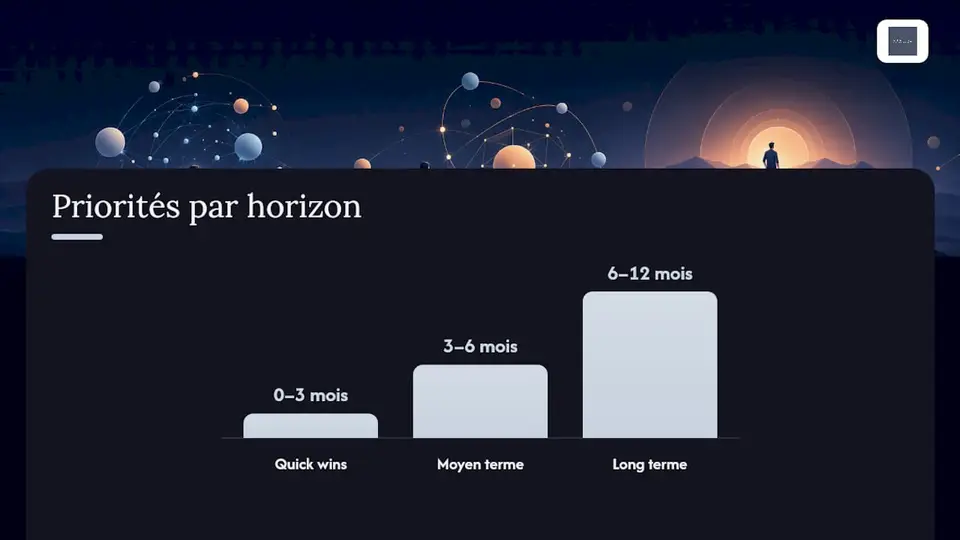
Medium-term initiatives (3 to 6 months) require more production work: cover topics where your brand is absent from AI answers, strengthen your entity presence on third-party platforms, and enrich existing content with dated statistics and verifiable sources.
Long-term initiatives (6 to 12 months) focus on external authority: secure mentions in recognized media outlets, build or enrich a legitimate Wikipedia presence, and establish recurring content partnerships.
- Quarter 1: initial audit, technical fixes, and chunking of strategic pages.
- Quarter 2: targeted content production to address identified gaps, and targeted PR.
- Quarter 3: entity consolidation and initial co-citation partnerships.
- Quarter 4: full reassessment of the visibility score and roadmap adjustments.
Pro tip: Never launch an external authority initiative (Wikipedia, media) before fixing your technical foundations. A news article linking to a poorly structured page wastes a citation opportunity that will not easily come around again.
What results can you expect from an LLM visibility audit?
Gains are measured in two stages. Technical and editorial fixes produce visible effects in 30 to 90 days: better content extraction and initial citations for prompts that previously returned no mentions. Building external authority generally takes 6 to 12 months before it translates into a stable AI share of voice.
A successful audit delivers at least the following:
- A documented baseline and an established initial visibility score.
- A roadmap prioritized by impact and effort across three time horizons.
- An active dashboard tracking visibility, quality, and referral traffic.
Wise Mirror's perspective and field evidence
The most common mistake we see at Wise Mirror is not technical but organizational: marketing teams treat an LLM visibility audit as a one-off project, when it works like traditional social listening monitoring—continuously. A strategic audit provides the diagnosis and prioritizes initiatives; without regular follow-up, the score deteriorates as soon as models are retrained or a competitor publishes faster than you.
Our social listening experience teaches us one thing: the weak signals that foreshadow a loss of AI visibility often resemble those that precede a traditional reputational decline. That is why we systematically pair the initial audit with annual monitoring, supported by a crisis management protocol that can be activated if a generative answer starts spreading inaccurate information about your brand.
— GB
The Wise Mirror strategic audit for managing AI visibility
Unlike a generic SEO audit that stops at rankings, Wise Mirror's strategic audit combines multi-LLM testing, documented scoring, and an operational roadmap across three time horizons, all backed by our social listening expertise rather than a simple automated crawl.

Two formats are available depending on your maturity: a standard audit to establish your baseline and immediate priorities, and a premium package including continuous monitoring to track your score month after month. For brands already exposed to controversies or sensitive news coverage, our crisis management service, available for activation around the clock, can be added as soon as a warning signal appears in monitored generative answers. This work forms part of a broader social monitoring approach, detailed in our article on using AI for effective social monitoring.
Want to know exactly where your brand appears—or disappears—in generative AI answers? Request a personalized assessment on the Wise Mirror Social Intelligence page.
Further reading
For a deeper look at the methodology, our guide to AI and marketing conversation analysis details conversational analysis protocols applied to social listening. Teams just getting started will benefit from reading our digital positioning audit before tackling the LLM-specific component. For technical implementation, the practical guide to integrating AI into your business (in French) offers concrete steps that require no prior technical expertise.
Sources
- AI Visibility Audit | Ahrefs (FR) (in French)
- What is Generative Engine Optimization? | Search Engine Land
- Generative Engine Optimization | Semrush
Frequently asked questions
What exactly is an LLM visibility audit?
It is an assessment of your brand's presence, information accuracy, and associated sentiment in answers from models such as ChatGPT, Perplexity, or Gemini, resulting in a prioritized roadmap.
How long does it take to see results?
Technical and editorial fixes produce effects in 30 to 90 days, while building external authority generally takes 6 to 12 months.
How does GEO differ from traditional SEO?
SEO targets a ranking in a list of results, while GEO targets a citation or direct mention in a synthesized AI-generated answer.
How many prompts should you test for a reliable audit?
A sample of 10 to 30 representative prompts is enough for a reliable baseline, with some more extensive audits covering up to 80 queries.
Does Wise Mirror offer follow-up after the initial audit?
Yes, Wise Mirror's annual monitoring service extends the strategic audit with continuous visibility score tracking and crisis management that can be activated if issues arise.