Online reputation audit method: a reusable framework for communications teams

A reliable online reputation audit method follows a simple sequence: define the scope, map the channels, collect mentions, analyze them using weighted scoring, develop a prioritized action plan, then present everything in a report with ongoing KPI tracking. The final deliverable combines a quantitative assessment and a prioritized roadmap, drawing on Google, social listening tools, and human interpretation of weak signals.
At a glance:
- Channel mapping should follow a concentric approach, covering official websites, earned channels, then anonymous discussions and conversational search engines.
- Tool selection depends on the organization's size, with professional solutions capable of continuously cross-referencing thousands of sources for effective monitoring.
- Sentiment analysis must always be validated by a human, particularly to detect sarcasm, irony, or ambiguity, and cross-checked through qualitative review.
- Mention scoring relies on visibility, sentiment, and business relevance criteria to prioritize corrective actions effectively.
- Regular tracking, with annual audits and continuous monitoring, is essential to anticipate crises and strengthen online reputation resilience.
Table of contents
- What is an online reputation audit, and what should it achieve?
- How do you map all the channels to monitor?
- Which tools should you use to collect monitoring data?
- How do you analyze sentiment and prioritize findings?
- How do you turn the assessment into an action plan?
- How should you present the audit, and which metrics should you track?
- Quick checklist: audit your online reputation in 30 to 90 minutes
- What method and evidence underpin the Wise Mirror approach?
- Why auditing should become a governance habit
- Move from one-off audits to structured monitoring with Wise-mirror
- Sources
- Frequently asked questions
What is an online reputation audit, and what should it achieve?
An online reputation audit captures a snapshot of everything being said about an organization across the web and social media, then identifies priorities for action. It is not simply a Google search: it is a structured process combining quantitative data (volumes, sentiment, rankings) with a qualitative interpretation of business implications.
The most common mistake is launching an audit without measurable objectives. A successful audit aims for concrete outcomes, not just a temperature check.
- Push negative mentions down from the first page of Google search results.
- Improve an overall sentiment score over a given period (for example, moving from a 60/40 negative-to-positive ratio to 40/60).
- Identify three to five emerging crisis topics before they erupt publicly.
- Document a baseline to measure the impact of future actions.
The scope must be defined from the outset: brand(s), high-profile executives, subsidiaries, flagship products, and sometimes direct competitors for context. As for stakeholders, the communications department generally leads the exercise, but marketing, public relations, legal, and sometimes human resources should be involved, if only to validate sensitive areas (employer reviews, ongoing disputes, CSR issues). A well-scoped brand image audit always benefits from clarifying these roles at the start.
How do you map all the channels to monitor?
Mapping works best in concentric circles. At the center are the organization's owned channels (website, official social media accounts, blog). Around them are identifiable earned channels (press coverage, indexed customer reviews, forums where the brand is explicitly mentioned). At the edges are the areas hardest to cover: untagged mentions, anonymous discussions, and summaries generated by conversational search engines.
An online reputation audit limited to Google Alerts misses the essentials. A robust method structures monitoring in several layers: traditional search engines, social media, specialist forums, AI search engines, employer review platforms, and trade media, as detailed in the PR-Insiders online reputation audit checklist (in French). Follow this sequence to ensure nothing is overlooked:
- Review the Google SERP for the brand, its executives, and its flagship products, including the Knowledge Graph and rich snippets displayed at the top of the page.
- Check the Google Business Profile listing: ratings, recent reviews, public questions and answers, and photos added by third parties.
- Explore review platforms relevant to the industry (consumer reviews, comparison sites, specialist B2B platforms).
- Search forums and communities where the brand may be discussed without being identifiable through a simple hashtag.
- Test conversational search engines (such as ChatGPT and Perplexity) using several query formulations to see what summaries they produce about the organization, an audit layer still too often overlooked even though it already influences journalists and some decision-makers.
- Cross-check across social media broadly, including accessible private groups and comments on third-party posts.
The goal at this stage is not absolute completeness, which is impossible to achieve, but coverage of the areas with the greatest business risk.
Which tools should you use to collect monitoring data?
The choice of tool depends directly on the organization's size and the sensitivity of the subject. A very small business may manage with free alerts and occasional manual searches. An organization with media exposure, multiple brands, or sensitive HR developments needs professional social listening solutions capable of continuously cross-referencing thousands of sources and detecting volume spikes in real time.
Professional tools capture untagged mentions that free tools miss almost systematically, a point confirmed by La Fabrique du Net's methodological analyses (in French). In practice, this means identifying conversations where the brand is named without an official account tag or dedicated hashtag, which often represent a significant share of the actual discussion volume.
Apply these best practices from the setup stage:
- Build Boolean queries combining the brand name, spelling variants, common misspellings, and internal nicknames.
- Exclude recurring false positives (identical names or other entities with similar names).
- Test search result neutrality in private browsing mode to avoid personalization biases linked to the account's browsing history.
- Systematically document SERP screenshots and AI summaries, as these results change quickly and are not archived elsewhere.
- Always cross-check automated tools with human review before drawing conclusions about a message's sentiment.
Pro tip: Run the same search on three different conversational search engines using slightly varied wording. Differences in their answers often reveal areas where perceptions are unstable, while a traditional social listening score reveals nothing.
How do you analyze sentiment and prioritize findings?
Automated sentiment analysis regularly misinterprets irony, sarcasm, and ambiguous phrasing in everyday language. Algorithms help sort large volumes of mentions, but human validation remains essential before any decision, a principle shared by industry guides on social listening and weak signal detection.
Two tasks structure this stage. First, thematic categorization: grouping mentions by topic (product, customer service, pricing, executives, CSR) to identify areas of tension rather than handling each message in isolation. Next, identifying the voices that truly matter, whether recurring detractors or high-reach accounts capable of amplifying a message, an analysis aligned with influence network mapping.
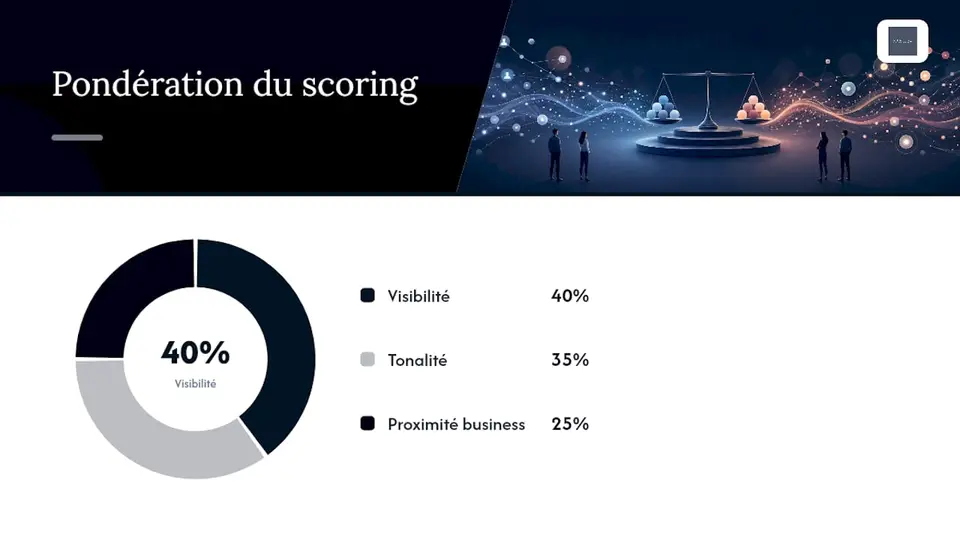
Scoring comes next, turning a spreadsheet of mentions into a management tool. A common method weights three dimensions: visibility (position in search results), sentiment, and business relevance. Some consultants recommend weighting visibility at 40%, sentiment at 35%, and business relevance at 25%, a breakdown notably proposed by PR-Insiders.
| Criterion | Weight | Example of a high score | Interpretation |
|---|---|---|---|
| Visibility (SERP position) | 40% | Page 1 result, top 3 | High priority, immediate impact on perception |
| Sentiment | 35% | Highly negative, viral content | Risk of spread, rapid response required |
| Business relevance | 25% | Targets a flagship product or an executive | Direct effect on sales or trust |
A high overall score across all three dimensions signals an urgent issue requiring top priority; a high score on just one dimension warrants closer monitoring rather than immediate action.
How do you turn the assessment into an action plan?
Not all negative mentions should be handled the same way. The choice between removal, search result suppression, and content creation depends on the medium, the content's legality, and its position in search results.
Removal (through reporting or a takedown request) works only for content that is defamatory, illegal, or clearly violates a platform's terms of use. Search result suppression, which involves raising positive or neutral content to push negative content onto page 2 or 3, applies to everything else, particularly legitimate low-rated customer reviews.
- Respond consistently to negative reviews, publicly and calmly, rather than ignoring them.
- Launch an active review request campaign to dilute older or isolated feedback.
- Strengthen SEO for official pages targeting sensitive branded queries.
- Engage media relations to recirculate recent positive news.
- Activate employee advocacy to humanize the brand on social media.
| Action | Impact | Effort | Estimated timeframe |
|---|---|---|---|
| Responding to negative reviews | Medium | Low | 1 to 2 weeks |
| Review request campaign | High | Medium | 1 to 3 months |
| Strengthening branded SEO | High | High | 3 to 6 months |
| Targeted media relations | Medium to high | Medium | 1 to 2 months |
How should you present the audit, and which metrics should you track?
A useful online reputation audit report follows a simple structure: a factual assessment, a detailed scorecard, prioritized recommendations, then a roadmap with deadlines. The educational resources from OpenClassrooms on online reputation management (in French) also emphasize the importance of making this type of report accessible to nonspecialists, including senior management.
The metrics to track combine volume and perceived quality:
- Average Google rating and review response rate.
- Share of positive, neutral, and negative mentions over a given period.
- Number of negative results on the first search results page for branded queries.
- Resolution rate for reported issues or open disputes.
- Volume of mentions in conversational search engines and sentiment of the summaries generated.
To make sense of these figures, it helps to relate them to broader marketing metrics, as highlighted in this guide to digital performance indicators (in French). A full audit every 12 months provides a good foundation, complemented by continuous monitoring to detect weak signals between formal reviews. Find a more detailed framework in this guide to reputation metrics for public organizations.
Quick checklist: audit your online reputation in 30 to 90 minutes
- 10 minutes: search for the brand and its executives on Google in private browsing mode.
- 15 minutes: check the Google Business Profile listing and recent unaddressed reviews.
- 20 minutes: review mentions on two or three priority social networks.
- 20 minutes: test two conversational search engines with varied queries.
- 15 minutes: note any alert thresholds that have been crossed.
A useful benchmark from RepondreAvis (in French): an average Google rating below 4.2, a review response rate below 80%, or recent unanswered reviews signal a need for immediate action rather than monitoring alone.
What method and evidence underpin the Wise Mirror approach?
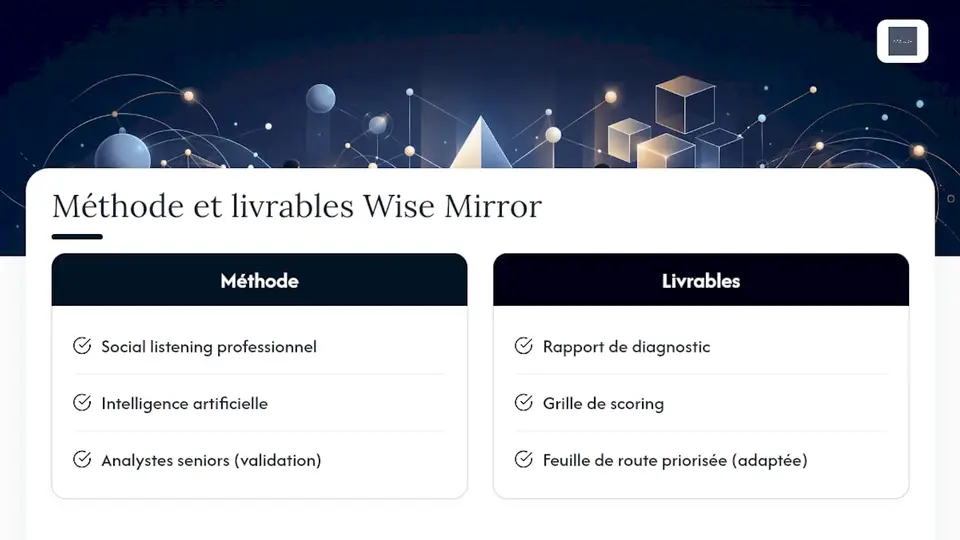
Each engagement combines professional social listening, artificial intelligence, and senior analysts to validate weak signals before presenting findings. Deliverables always include an assessment report, a scorecard, and a prioritized roadmap, tailored to each organization's scope and specific challenges.
Why auditing should become a governance habit
A one-off audit loses its value if it remains an isolated exercise. Integrating it into a regular cycle, alongside continuous monitoring and governance committees, enables action before a crisis rather than leaving the organization to endure it. Organizations that manage these metrics at the senior leadership level, not just within communications, gain valuable time when a weak signal intensifies. Reputational resilience is built on this consistency, not on reaction.
— GB
Move from one-off audits to structured monitoring with Wise-mirror
An audit provides an assessment at a specific moment, but online reputation evolves every week. Wise-mirror offers three complementary services to address this need: a strategic audit to establish the initial assessment, annual monitoring to track changes over time through social listening and artificial intelligence, and crisis management available at any time to respond as soon as a signal escalates.

Each engagement involves senior analysts who manually validate tool-generated results, avoiding the false positives that frequently arise from irony or identical names. Deliverables remain practical: a scoring report, an influencer map, and a prioritized roadmap. To scope your next audit or establish continuous monitoring, explore Wise Mirror's social intelligence services and discuss your scope with the team.
Sources
- Online reputation audit: how to conduct it effectively — La Fabrique du Net (in French)
- Corporate online reputation: a checklist for an audit that goes beyond Google Alerts — PR-Insiders (in French)
- Online reputation audit: how to assess your online image in 5 steps (2026) — RepondreAvis (in French)
- Manage your online reputation and brand influence — OpenClassrooms (in French)
Frequently asked questions
What are the 4 types of online reputation audit?
The four commonly recognized types are awareness audits (volume and reach), sentiment audits (positive or negative perception), competitive audits (relative positioning), and crisis audits (detecting weak signals before escalation).
How can you check your online reputation yourself?
Search for your brand on Google in private browsing mode, check your Google Business Profile listing, review customer feedback, and test two conversational search engines using varied wording.
What are the 5 steps of an online reputation audit?
Scope definition, channel mapping, data collection, analysis and scoring, then a prioritized action plan with reporting and metric tracking.
How often should you repeat an online reputation audit?
A full audit every 12 months provides a good foundation, complemented by continuous monitoring such as that offered by Wise-mirror to detect weak signals between audits.
What is the difference between negative content removal and suppression?
Removal aims to delete illegal or defamatory content, while suppression involves raising positive content in search results to push down legitimate negative content that ranks too prominently.