AI Search Monitoring: How to Track Your Brand in AI Answers

AI search monitoring means measuring, on a regular schedule, whether ChatGPT, Perplexity, Gemini and Google’s AI features mention your organization, which pages they cite and how they describe you. The measurement only pays off if it ends in action: correcting what is wrong, filling what is missing and publishing content these engines can cite. That is why we treat monitoring as one link in a chain, from audit to continuous tracking to content, and why our SEO, GEO and LLM audit starts with a baseline before any dashboard is switched on.
TL;DR
- AI search monitoring tracks mentions, citations, sentiment and share of voice across several AI engines, not a ranking position on one results page.
- A single reading is unreliable: identical prompts can return different answers and sources, so you need repeated sampling and ranges, not one number.
- Start with a baseline (a fixed set of prompts, several engines, the same method each month), then track the trend and the sources the engines rely on.
- The findings belong to communications, marketing and digital teams alike: they show what to correct, which content to produce and which risks to escalate.
- Our audit gives you the baseline and an action plan; monitoring and content production keep it moving.
Table of Contents
- What AI search monitoring is, and how it differs from rank tracking
- Can you really track what AI engines say about you?
- The metrics worth tracking, and what each one tells you
- How reliable are the results?
- Building a monitoring program, step by step
- Why communications, marketing and digital teams should care
- From measurement to action with Wise Mirror
- Choosing a monitoring approach
- FAQ
- Sources
What AI search monitoring is, and how it differs from rank tracking
Classic rank tracking answers one question: at which position does my page appear for this keyword? The answer is a number, it is stable enough to compare week to week, and Google’s own tools report it.
An AI engine does not return ten blue links. It writes an answer, sometimes names brands, sometimes cites sources and sometimes does neither. So the questions change:
- Is my organization named in the answer at all?
- Is it named first, among several, or as an afterthought?
- Which pages does the engine cite to support the answer: mine, a media article, a forum thread, a directory?
- Is the description accurate and is the tone favorable?
- How do I compare with the organizations I am usually measured against?
These are reputation questions as much as search questions, which is why the work sits between SEO, communications and brand teams. The label you will meet is GEO (generative engine optimization): the practice of making your organization easy for AI engines to find, understand and cite. Monitoring is the measuring half of it.
Can you really track what AI engines say about you?
Yes, with a caveat that shapes the whole method. You cannot read an engine’s internal ranking. What you can do is ask it questions the way your audience does and record what comes back. In practice, monitoring is a controlled repetition of that experiment:
- You define a list of prompts that reflect real buying, selection or reputation questions.
- You run them on a set of engines.
- You record whether you are mentioned, how, with which sources and with what sentiment.
- You repeat on a schedule and compare.
Google states that sites appearing in its AI features, AI Overviews and AI Mode, are counted within the overall search traffic in Search Console, under the Web search type of the Performance report (Google Search Central). That is useful for traffic, but it does not tell you how a brand is described, nor what happens in ChatGPT, Perplexity or Gemini. For that you need prompt-based monitoring.
The metrics worth tracking, and what each one tells you
Do not start with twenty indicators. Four cover most decisions.
| Metric | What it measures | What it tells you | Typical trap |
|---|---|---|---|
| Mention rate | Share of prompts where your organization is named | Whether the engines know you for the topics you care about | Counting a mention in a list of ten as equal to a recommendation |
| Citation rate | Share of answers that link to one of your pages | Whether your own content is a trusted source | Ignoring citations of third-party pages that talk about you |
| Share of voice | Your mentions relative to those of named peers | Your position against the organizations you are compared with | Choosing peers that your audience does not actually compare you to |
| Sentiment and accuracy | Tone and correctness of what is said | Reputation risk and outdated facts | Reading tone without checking facts such as prices, locations, leadership |
To see what a large-scale measurement looks like, take the French study by Eskimoz reported by Siècle Digital on 9 October 2025: it analyzed 1,200 sites and 50,000 prompts over 60 days and ranked brands by mention rate and estimated traffic. The same article reports ChatGPT citation rates of 64.4% for Le Monde and 53.3% for Le Figaro among French media. Two lessons for your own program: the unit is the prompt, and the sample must be large and repeated before a ranking means anything.
A fifth element is less glamorous and often the most actionable: the list of sources the engines cite when they talk about you. If the answer about your organization rests on a three-year-old directory entry or a forum thread, that is where the work is.
How reliable are the results?
This is the question that separates a useful program from a decorative dashboard. An academic paper on arXiv, Quantifying Uncertainty in AI Visibility, concludes that identical queries can yield different answers and different sources, and that estimates from a single reading give a misleading impression of precision. Its authors recommend treating citation measures as estimates of a distribution of answers, with uncertainty intervals, rather than as fixed values.
In practice, that means four rules:
- Repeat each prompt several times per period, not once.
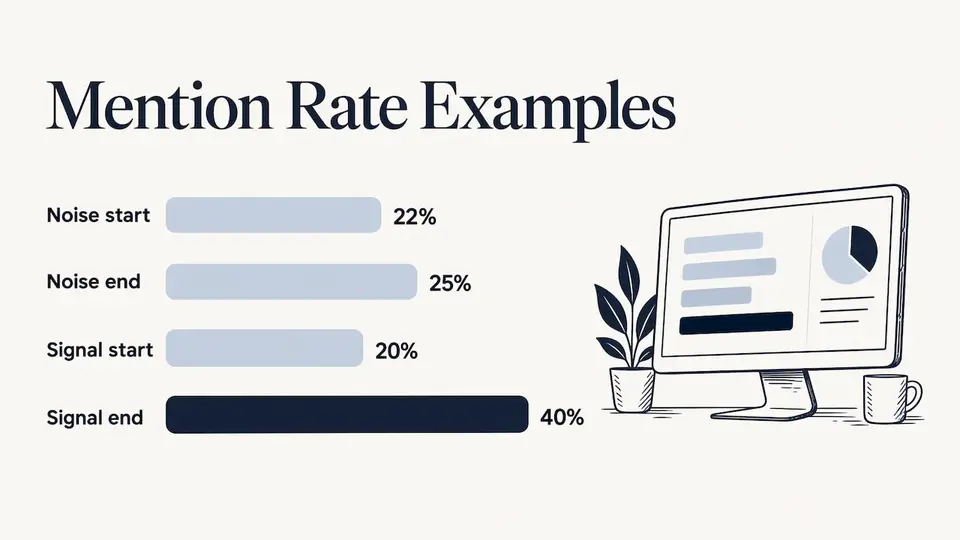
- Report ranges or trends, not a single percentage. A move from 22% to 25% mention rate may be noise; a move from 20% to 40% over three months is a signal.
- Keep the method constant: same prompts, same engines, same language, same wording, so that month-to-month comparisons mean something.
- Separate engines. ChatGPT, Perplexity, Gemini and Google’s AI features draw on different sources and behave differently, so a blended score hides what you can act on.
Google itself notes that AI Mode and AI Overviews may use different models and techniques, so the set of responses and links they show will vary (Google Search Central). Even within one product, two runs are not guaranteed to match.
Building a monitoring program, step by step
1. Define the questions your audience asks
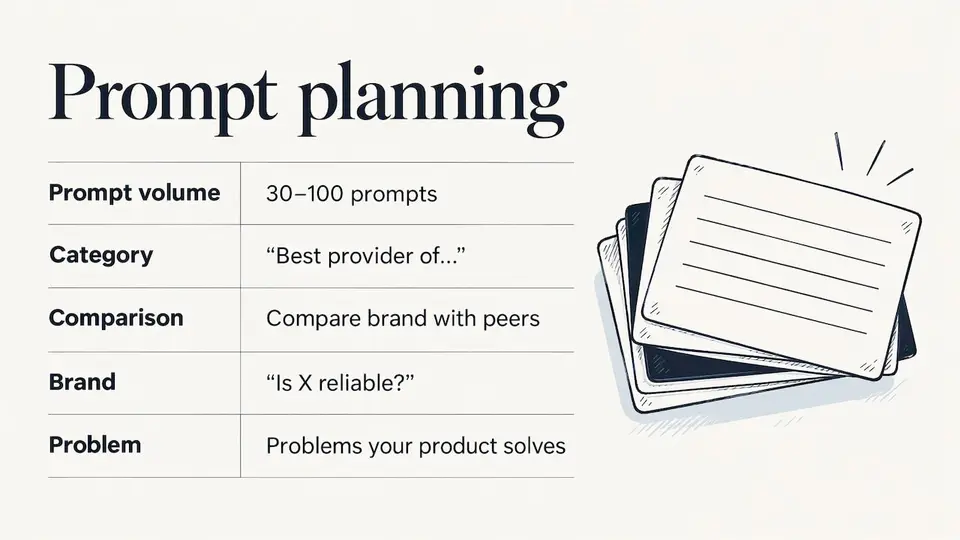
Start from real situations, not keywords. A public-sector director might track how an agency’s missions are described; a marketing director how the brand is compared with peers; a communications lead what is said after a controversy. Write 30 to 100 prompts across four families: category questions (“best provider of…”), comparison questions, brand questions (“is X reliable?”) and problem questions your product solves.
Where teams go wrong: prompts that only contain the brand name. They measure notoriety, not discoverability. Mix branded and unbranded prompts.
2. Choose the engines and the languages
Cover at least ChatGPT, Perplexity, Gemini and Google’s AI features, and add the engines your audience actually uses. For a French organization, run prompts in French first, then in the languages of your foreign markets. Our full SEO, GEO and LLM audit covers seven engines, with questions spanning a detailed service portfolio.
3. Capture a baseline
The first measurement is the most valuable, because every later number is judged against it. Record mention rate, citations, sentiment, factual errors and the sources used, per engine, with repeated runs. This is exactly the purpose of our audit: a light version delivered in 24 hours and a full version in two weeks, the latter with an action plan. The full audit is priced at €3,500 excl. VAT.
4. Set a rhythm and owners
Monthly reporting suits most organizations; weekly alerts make sense when reputation is sensitive. Decide who receives what: the communications lead gets accuracy and sentiment issues, the SEO or content team gets citation gaps, the executive committee gets the trend and share of voice.
5. Turn findings into a backlog
Each finding should map to an action:
- Missing from answers: the topic is not covered by content that engines can cite. Produce it.
- Cited but misdescribed: the source is outdated or ambiguous. Correct it at the source.
- Competitors cited instead: study which pages are cited and what they provide that yours do not.
- Negative or false statements: escalate, document and answer through channels the engines read.
6. Re-measure after each change
Generative engines update at their own pace. Give a change several weeks, then compare ranges, not single runs.
Why communications, marketing and digital teams should care
People now ask an engine for a shortlist or a summary before they ever visit a website. If your organization is absent from that answer, you are not in the consideration set; if it is present but described wrongly, you are being misrepresented at scale and nobody told you.
Three typical uses of the findings:
- Communications: detect inaccurate or outdated statements about leadership, services or past incidents, and see which sources feed them.
- Marketing: measure share of voice on the questions that precede a purchase and prioritize content accordingly.
- Digital and data teams: connect AI visibility with web analytics and Search Console, and build a stable measurement protocol with confidence ranges.
The topic also meets social listening. What people say on social networks and forums is often what AI engines later summarize. Watching both sides lets you act on the cause, not only the symptom. Our article on detecting weak signals in marketing explains how early signals are spotted before they become a trend.
From measurement to action with Wise Mirror
Most organizations do not lack dashboards; they lack someone who carries the finding through to the fix. We built our offers in three stages: audit, monitor, activate.
- Audit: the SEO, GEO and LLM audit measures your visibility in AI engines and ends with an action plan. A one-off Diagnostic I.A. is also available at €800.
- Monitor: Monitoring & Alerts provides continuous monitoring with live dashboards and a monthly report, at €5,000 excl. VAT per month.
- Activate: SEO/GEO Response, at €1,000 excl. VAT per month, and our content production, designed to be cited by AI engines, close the gaps the audit reveals. Our guide to content optimized for AI citation details the method.
We pair AI-enabled analysis and production with human strategic judgment, and we adapt to the operating constraints of your team. When a finding is a reputation emergency, our crisis management cell can be activated within 24 hours. You can see all options on our offers page.
Choosing a monitoring approach
Whatever route you take, judge it on criteria that decide whether the data is usable:
| Criterion | What to look for |
|---|---|
| Engine coverage | ChatGPT, Perplexity, Gemini and Google’s AI features, separately reported |
| Sampling | Repeated runs per prompt and ranges, not single readings |
| Prompt design | Branded and unbranded prompts built from real audience questions |
| Sources | A list of cited pages, not only a score |
| Accuracy checks | Factual verification of what is said, not just sentiment |
| Next step | A prioritized action plan and the capacity to execute it |
The last line is where programs stall. A score without an action plan produces a monthly slide; a score with content production and correction produces movement in the next measurement.
FAQ
How do I monitor AI search visibility?
Build a fixed list of prompts that reflect how your audience asks questions, run them repeatedly on several AI engines and record mentions, citations, sentiment and cited sources. Repeat monthly with the same method. Our audit sets up this baseline and adds an action plan.
Can AI searches be tracked?
Yes, but as samples rather than exact counts. Google reports traffic from its AI features inside the Search Console Performance report, while visibility in ChatGPT, Perplexity or Gemini has to be measured by running prompts and recording the answers. Because answers vary between runs, results should be read as ranges.
Is AI search monitoring the same as SEO rank tracking?
No. Rank tracking follows the position of a page for a keyword. AI search monitoring follows whether and how an engine mentions and cites your organization in a generated answer, including tone and accuracy. The two complement each other.
How often should we measure?
Monthly is enough for most organizations, with continuous alerts when reputation is at stake. The important point is a constant method and several runs per prompt, so changes are real and not noise.