How to Appear in Google AI Overviews: A Guide for France

Yes, your site can appear in AI Overviews if its pages are indexed, usable, and structured for extractability. Three actions take priority: check the “Generative AI features” report in Search Console, rewrite your key pages to open with a direct answer, and make sure nothing in your robots.txt inadvertently blocks Google. The rest of this article explains how to carry out each step.
At a glance:
- To appear in AI Overviews, your pages must be indexed, free of blocking directives, structured with a clear answer at the start, and contain content Google can extract.
- The system favors self-contained, precise passages that are easy to isolate, requiring clear writing, short blocks, and specific dates to strengthen credibility.
- Visibility in AI Overviews is measured primarily through Search Console, by analyzing click-through rates, overall traffic, and presence on branded or sensitive queries.
- For topics with significant regulatory or reputational stakes, limiting exposure is advisable, but opting out entirely risks losing all future visibility.
- A technical and editorial audit, such as the one offered by Wise-mirror, helps optimize your presence in these Overviews while tracking changes over time.
Table of contents
- What are AI Overviews, and when did they arrive in France?
- How does Google select sources for AI Overviews?
- Technical checklist: indexing, robots.txt, and page rendering
- How to write content for extraction by AI Overviews
- How to measure your appearances in AI Overviews
- AI Overviews and traffic: what effects should you expect?
- How Wise-mirror audits a site's readiness for AI Overviews
- Should you target AI Overviews or opt out in Search Console?
- Wise-mirror support to turn AI visibility into measurable results
- Sources
- Frequently asked questions
What are AI Overviews, and when did they arrive in France?
An AI Overview is a Google-generated summary that appears at the top of the results page, synthesizes multiple sources, and cites the original pages with clickable links. Unlike a featured snippet, which extracts a single passage from one page, an AI Overview combines multiple sources to formulate a comprehensive answer in its own words.
Google enabled AI Overviews and AI Mode in France on July 22, 2026 (in French), changing the landscape for French SEO teams that had previously been following developments in the United States or Canada. The feature primarily targets informational queries, comparisons, and questions requiring a multipart answer—those where users want to understand something rather than click through to a specific site.
AI Mode goes further: it turns search into a conversation, with opportunities for follow-up questions. AI Overviews, meanwhile, remain integrated into the standard results page, and users can still switch to the “Web” tab for a traditional list of links, as explained in Google Search Help (in French).
How does Google select sources for AI Overviews?
Google does not trigger an AI Overview for every query. The system first assesses whether a generative summary offers a meaningful advantage over a traditional list of links. When it does, it draws on its existing index—the same one that powers organic search—to identify the most relevant passages, then a generative model reformulates them into a coherent answer while retaining citations to the source pages.
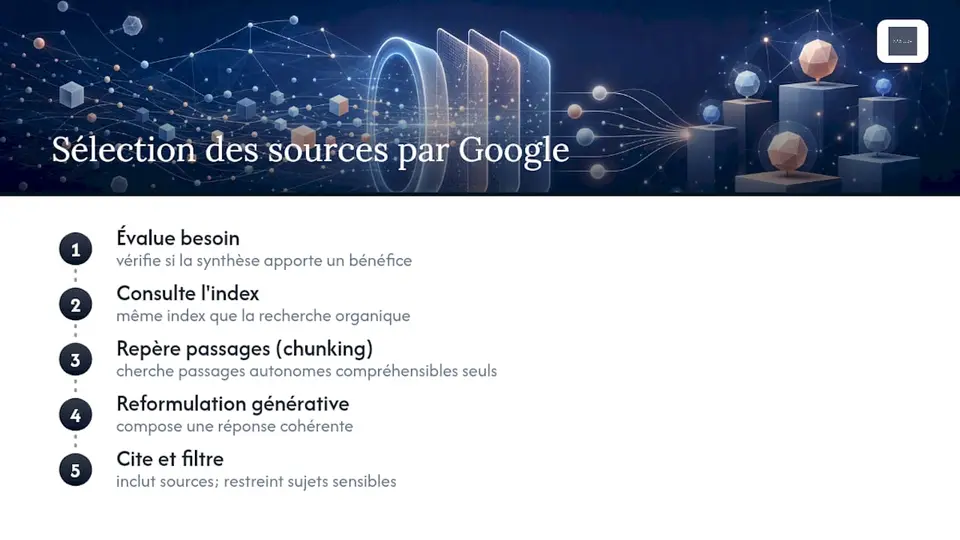
This mechanism rests on a core technical principle: “chunking.” This refers to a page's ability to contain self-contained passages that make sense in isolation, without depending on the preceding paragraph. A page made up of tightly interlinked sentences, without ever presenting a complete idea in a single block, offers little usable material for the algorithm. By contrast, a paragraph that fully answers a specific subquestion becomes a natural candidate for citation.
The system is not perfect, and Google implicitly acknowledges this. On sensitive topics with significant legal or health implications, AI Overviews remain more restricted: regulatory considerations in Europe (in French) push Google to limit automated summaries when the risk of error or misinformation is high. This caution also reflects an issue of editorial responsibility: an automatically generated answer that gets a medical or financial topic wrong exposes both the cited company and Google itself to risk. For your content, this means that topics with significant reputational stakes require especially rigorous treatment, supported by sources and dates.
Technical checklist: indexing, robots.txt, and page rendering
Before you even consider editorial style, a page must meet strict technical requirements. Google's developer documentation (in French) is clear on this point: a page must be indexed, allow crawling, and carry no blocking directives such as noindex or nosnippet.
Here are the checks to carry out, in order:
- Check in Search Console that your strategic pages are indexed, using the coverage report and your up-to-date XML sitemap.
- Inspect your server logs to confirm that Google crawlers actually visit, rather than simply having permission to do so.
- Check that the pages you want cited have no
noindexornosnippettags. - Configure your robots.txt file to allow the relevant crawlers: a common strategy is to block GPTBot for model training while allowing real-time search crawlers such as OAI-SearchBot, an approach documented by ADN IA (in French) to preserve citations without making your content available for training.
- Make sure your content is visible without client-side JavaScript execution: server-side rendering (SSR) or static site generation (SSG) eliminates the risk of a crawler seeing only an empty page.
- Use the
data-nosnippettag sparingly, only on text sections you never want quoted verbatim.
Pro tip: never block an AI crawler as a defensive reflex without first measuring the impact. Opting out entirely protects you from an unwanted citation, but it also removes all future visibility through this channel, including when it becomes a significant traffic source.
How to write content for extraction by AI Overviews
Editorial structure matters as much as technical implementation. A perfectly indexed site written in long, uninterrupted narrative paragraphs offers nothing to extract. Three principles govern writing designed for this format.
- Answer before explaining. Place the direct answer to the question within the first two sentences of the paragraph or section, then develop the context, nuances, and exceptions. This is the BLUF (bottom line up front) principle: generative AI favors passages that state a clear conclusion before supporting it.
- Break content into self-contained blocks. Descriptive headings, short paragraphs, numbered lists, and question-and-answer formats create units of meaning the algorithm can isolate without losing the thread. A guide to optimizing for Google AI Overviews explains how to restructure an existing page around this principle.
- Date and source your claims. A dated figure, a statistic attributed to a verifiable source, and a precise definition strengthen your credibility with both the generative model and the reader. This also forms the foundation of E-E-A-T (experience, expertise, authoritativeness, trustworthiness), the framework Google uses to assess a page's quality before citing it.
Writing for extraction does not mean sacrificing depth. A page that gives an initial answer and then develops a complete line of reasoning retains its full value for readers who click through despite the overview, which remains the ultimate goal. A method for earning a citation in 40 to 60 words illustrates this balance between extractable brevity and substantive content.
How to measure your appearances in AI Overviews
Tracking starts with Search Console, which offers a dedicated “Generative AI features” report. This report displays impressions and clicks specifically associated with appearances in AI Overviews, separately from other search features.
To interpret this data correctly, cross-reference several metrics:
- The click-through rate (CTR) for queries where your page appears in an AI Overview, compared with the usual CTR for those same queries in traditional search.
- Changes in overall organic traffic over the period, to distinguish a decline linked to AI Overviews from one caused by other factors (seasonality, algorithms, competition).
- Branded queries, often a good indicator of your site's perceived value even when direct clicks decline for generic queries.
- Server logs and tools such as Bing Webmaster Tools, which help assess your visibility across other generative engines not covered by Search Console.
An LLM visibility audit framework helps structure this monitoring over time rather than treating it as a one-off check.
AI Overviews and traffic: what effects should you expect?
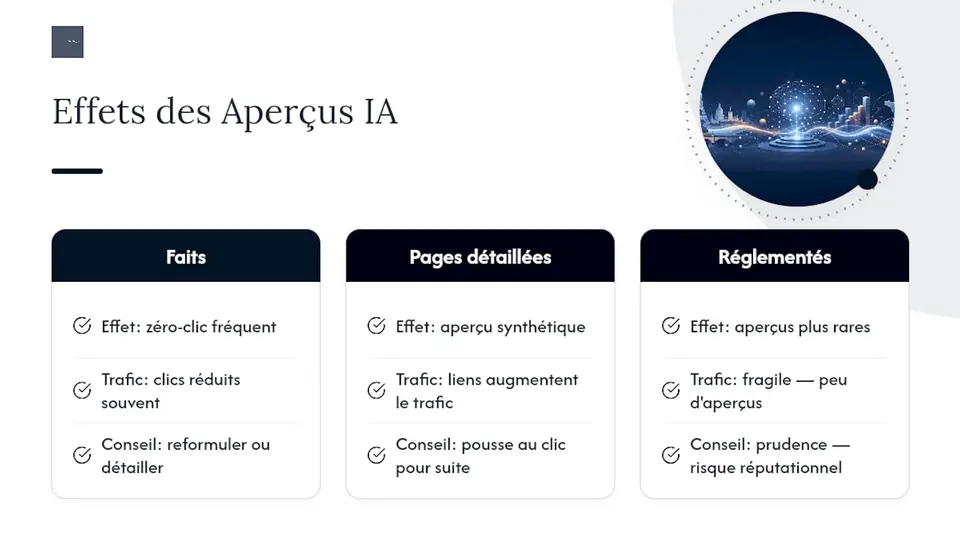
The most common concern remains zero-click search: an AI Overview that fully answers a question could discourage users from clicking. This effect is real for purely factual queries where a short answer is enough. However, Google's experiments show that overview designs clearly displaying links to source sites have instead increased traffic to those sites during testing.
The difference comes down to page type. A detailed guide, a specific commercial offer, or a downloadable document retains its value after the overview, because the overview remains concise and encourages clicks for full instructions. Be cautious with regulated topics (health, finance, law): AI Overviews are less common in these areas, and an inaccurate citation on these subjects creates a disproportionate reputational risk.
How Wise-mirror audits a site's readiness for AI Overviews
The audit starts with a full site crawl to check actual indexing, passage extractability, and the consistency of mentioned entities (brand name, products, executives) across pages. This is followed by an analysis of external mentions, which Google and generative models cross-reference to assess a source's reliability.
Deliverables include a technical checklist, editorial recommendations, and a dashboard for tracking appearances over time. The engagement unfolds in several phases: an initial audit, implementation of priority actions, and then continuous monitoring to adjust the strategy as Google's criteria evolve.
Should you target AI Overviews or opt out in Search Console?
This question deserves consideration on an organization-by-organization basis. Since June 2026, Search Console has allowed certain properties to be excluded from generative AI features, but this exclusion also removes all citations and any potential traffic they might generate. It is not a simple switch without consequences.
Three criteria should guide the decision: the actual value of the traffic involved, the reputational risk if a generated answer distorts your message, and the nature of the content (factual and stable, or nuanced and evolving). For most informational or commercial sites, opting out costs more than it protects. I recommend testing exposure within a limited scope, measuring it for a few months through the dedicated report, and then adjusting editorial governance based on the results rather than making a blind decision at the outset.
— GB
Wise-mirror support to turn AI visibility into measurable results
Wise-mirror offers an alternative to technical improvisation for teams that want to know exactly where they stand on AI Overviews, without multiplying tools and assumptions. Our difference comes down to one simple point: the audit does not stop at a diagnosis; it leads to a dashboard connected to Search Console that your teams can track month after month.

The offering comes in three complementary formats. A technical and editorial audit provides a complete assessment: indexing, extractability, entity consistency, and external mentions. A monitoring service tracks changes in visibility over time, with regular reviews to make adjustments. A crisis management service can step in if an AI citation distorts your image or creates reputational risk.
To assess where your site stands today and which pages deserve priority, contact the Wise-mirror agency for an initial discussion of your situation.
Sources
For a deeper technical understanding, Google's developer documentation on AI features remains the reference for eligibility criteria. The GEO playbook from The Mindset Motivator usefully complements this approach with optimization ideas for generative engines more broadly, while wemaco sheds light on multilingual indexing challenges.
- Google developer guides — AI features (in French)
- Google Search Help — AI Overviews (in French)
- Leptidigital — Google enables AI Overviews in France (in French)
Frequently asked questions
How can your site appear in an AI Overview?
Your pages must first be indexed and free of blocking directives (noindex, nosnippet), then structured with a direct answer at the start and self-contained passages the algorithm can easily extract.
What is an AI-generated overview?
An AI Overview is a Google-produced summary that synthesizes multiple web sources into a single answer, displayed at the top of search results with clickable links to the cited pages.
Which AI is best for French?
The main generative models—both those powering Google AI Overviews and consumer conversational assistants—all process French, but their quality varies depending on the depth and structure of the French-language source content available on a given topic.
Can you track your site's appearances in AI Overviews?
Yes, through Search Console's “Generative AI features” report, which reports impressions and clicks specific to these appearances, a metric Wise-mirror teams consistently incorporate into their monitoring dashboards.
Should you block AI crawlers in your robots.txt file?
Not necessarily across the board: blocking a training crawler such as GPTBot while allowing real-time search crawlers often preserves citations without making your content available for third-party model training.