Analyzing Consumer Trends on Social Media: 2026 Method

Detecting a consumer trend on social media and turning it into marketing action follows a precise sequence: signal collection, automated detection, contextual validation, then activation. Skipping a step, particularly validation, is the number one reason campaigns miss their mark.
Three indicators deserve your immediate attention:
- Volume: how many mentions, across which formats, and over what period.
- Velocity: the rate at which mentions accelerate, often more revealing than raw volume.
- Relative share of voice: your topic compared with the overall conversation in your category.
A significant majority of 15–25-year-olds have already bought a product after discovering it on social media, according to the OpinionWay survey for Orisha Commerce (in French). Ignoring this discovery channel means ignoring the primary entry point for an entire generation of buyers.
Key takeaways
Detecting a consumer trend requires combining volume, velocity, and human validation before any marketing activation.
| Point | Details |
|---|---|
| Four-stage sequence | Collection, automated detection, qualitative validation, then rapid activation within a limited scope. |
| Priority KPIs | Track volume, acceleration rate, share of voice, and the creator-to-audience ratio. |
| Mandatory validation | A spike in mentions driven by a single creator is not equivalent to a widely shared underlying trend. |
| Budget and timelines | Allow 2 to 4 weeks for an audit and cycles of 1 to 6 weeks for any test activation. |
| Recommended support | Wise-mirror combines senior analysts and integrated data for audits, monitoring, and crisis management. |
Useful sources and cited studies
For a deeper analysis of social media trends, draw on these publications:
- 2026 Social Media Observatory, Médiamétrie (in French)
- Myths and limits of influence on social media, Le Rubicon (in French)
- OpinionWay survey for Orisha Commerce (in French)
- SAP Engagement Cloud predictions for 2026 (in French)
- Social media: users under influence, LDH (in French)
These reports provide solid quantitative data to support an internal brief or budget proposal.
Table of contents
- Why analyzing consumer trends on social media has become urgent
- The seven-step method to detect and act on a trend
- Which KPIs distinguish a trend from short-lived noise?
- Which biases and limitations should you keep in mind?
- How much time and budget should you allow for social monitoring?
- Five questions to ask before hiring a provider
- What practical experience teaches about trend detection
- How Wise-mirror turns social monitoring into concrete decisions
- Sources
- Frequently asked questions
Why analyzing consumer trends on social media has become urgent
Usage patterns leave no room for doubt. A large majority of 11–17-year-olds use social media daily, and that proportion is even higher among 18–24-year-olds, according to Fondation Jean-Jaurès. Even more strikingly, a substantial number of 15–24-year-olds report changing a behavior after seeing social media content. These platforms no longer reflect opinions; they shape them.
The flip side is the volatility of attention. The 2026 Social Media Observatory from Médiamétrie (in French) identifies repetitive content as the leading reason people unfollow accounts. A brand that follows a trend without refreshing its approach loses its audience as quickly as it gained it. That is why a structured monitoring system is more valuable than ad hoc tracking.
The seven-step method to detect and act on a trend
Here is the sequence followed by most marketing teams that treat social monitoring as an ongoing function rather than a one-off exercise.
- Define the objective and hypotheses. Are you looking for conversions, increased awareness, or product insights? The answer determines which sources and KPIs to prioritize.
- Collect sources. Combine native platform APIs, hashtags, brand keywords, and niche communities to avoid the blind spots of relying on a single source.
- Detect using rules and models. Identify volume, acceleration, keyword co-occurrences, and creators who amplify the conversation before others do.
- Validate qualitatively. Manually review a sample of conversations. Check who is speaking, in what context, and whether the signal genuinely reflects your audience or only its most active users.
- Prioritize actions. Cross-reference the signal with your existing segments, messaging, and channels before launching.
- Activate quickly. Test through creators, a live format, or integrated commerce, using short cycles and continuously tracked KPIs.
- Close the learning loop. Feed results back into your CRM and sales data, and set the next monitoring window.
Each step produces a concrete deliverable: a hypothesis brief, a source table, a list of qualified signals, a validation summary, an activation plan, a test report, and an updated monitoring schedule.
Pro tip: Never validate a strong signal based on volume alone. A spike in mentions generated by a single creator with a large following is nothing like an underlying movement driven by thousands of independent conversations; the report from Le Rubicon (in French) notes that online influence primarily reinforces existing beliefs rather than creating them.
Which KPIs distinguish a trend from short-lived noise?
Mention volume and velocity form the foundation, but they are not enough on their own. A sudden acceleration without conversational depth often fades as quickly as it rises.
- Volume and velocity: number of mentions and acceleration rate within a given window.
- Relative share of voice: your topic compared with the category's total volume.
- Intent signals: discovery queries, purchase mentions, and shared product reviews.
- Sentiment quality: contextualized sentiment, rather than simply positive or negative, and the depth of exchanges.
- Social-to-sales conversion rate: the bridge between engagement and actual purchases.
- Creator-to-audience ratio: a signal driven by a single creator carries different weight from one distributed across hundreds of accounts.
This last metric matters particularly for Generation Z, where most prefer other users' reviews to recommendations from a tool or artificial intelligence, according to the same OpinionWay survey. Social proof remains the hardest qualitative KPI to automate, yet the most decisive.
Which biases and limitations should you keep in mind?
Recommendation algorithms filter what you see before you even try to analyze it. An analysis by Ligue des droits de l’homme (in French) shows that these architectures encourage polarization and, through repeated exposure, can distort perceptions of a social signal until it appears more widely accepted than it really is.
- Echo chambers: a strong signal in your sample may be an algorithmic artifact rather than a genuine market shift.
- Sampling bias: the most active and vocal users never represent your entire audience.
- Ethical considerations: Fondation Jean-Jaurès documents how ordinary, non-extreme content has a lasting influence on younger people's behavior. A brand that exploits a signal without assessing its impact takes a real reputational risk.
For a public organization or one managing a crisis, this caution is not optional: a poorly validated signal shared too quickly can amplify misinformation rather than contain it.
How much time and budget should you allow for social monitoring?
- Initial audit: 2 to 4 weeks, including scoping, collecting a representative sample, and delivering a strategic report.
- Monitoring setup: 2 to 6 weeks depending on the integrations required, including dashboards, an alert system, and detection model calibration.
- Ongoing monitoring subscription: a recurring cost that depends on scope and service level, ranging from basic weekly monitoring to round-the-clock crisis management coverage.
- Activation and experimentation: short cycles of 1 to 6 weeks, with budgets varying considerably by test scope, from a one-off creator collaboration to a multiformat campaign.
For a small project, plan primarily for internal analysis time. For a medium-to-large project, CRM integration and reporting frequency have a greater impact on the budget than data collection itself. An approach to integrating social data into strategic decision-making helps frame these trade-offs early.
Five questions to ask before hiring a provider
Before signing, make sure the provider clearly addresses these points.
- What is their detection methodology, and can they give concrete examples of trends they identified before they became widely visible?
- Do they have direct access to platform APIs, and can they integrate with your CRM or export usable raw data?
- What service commitments do they offer for real-time reporting, alert frequency, and response times for critical signals?
- Do they have senior analysts capable of qualitatively validating a signal beyond the automated dashboard?
- How do they manage confidentiality and compliance for the data collected?
- Always ask for real use cases, not just a presentation of tools.
- Check the claimed data reliability before committing to a long-term subscription.
What practical experience teaches about trend detection
Automation alone is never enough. Detection models identify spikes; senior analysts determine which ones warrant action by cross-referencing the signal with the current business and societal context. At Wise-mirror, this combination of artificial intelligence and human interpretation remains the difference between an ignored alert and an opportunity seized in time.

It is better to test quickly within a limited scope than to wait for certainty that will never come. A social media trend is rarely confirmed with 100% certainty (in French) before action is taken: it is validated through small, measured experiments.
How Wise-mirror turns social monitoring into concrete decisions
Wise-mirror offers three formats tailored to different needs: a strategic audit to capture your current position, annual monitoring to continuously track how your image evolves, and crisis management available around the clock when an incident occurs.

What sets this approach apart is the combination of senior analysts and direct integration of social data with your own business indicators, rather than a dashboard delivered without critical interpretation. Every detected signal undergoes human validation before becoming an actionable recommendation, whether for a product launch, a messaging adjustment, or a rapid response to negative buzz. To assess your current social media position and identify the signals that truly matter to your industry, request an audit from the Wise-mirror team.
Sources
Combining native platform APIs, social listening platforms, and CRM data provides a more reliable picture than any single source.
- 2026 Social Media Observatory | Médiamétrie (in French)
- Myths and limits of influence on social media - Le Rubicon (in French)
- Generation Z: social commerce comes first, AI inspires even less trust than peers — Renseignement Économique (in French)
Frequently asked questions
What is the first step in analyzing a social media trend?
Define the business objective, whether conversion, awareness, or product insights, before collecting any signals; otherwise, detection lacks direction.
How long does it take to validate a signal as a genuine trend?
Generally, allow a few days to two weeks of tracking acceleration and conversational depth before treating a signal as reliable.
Which indicators distinguish a real trend from a simple spike?
Relative share of voice, the diversity of creators involved, and the social-to-sales conversion rate matter more than raw mention volume.
When should you use a provider like Wise-mirror instead of internal monitoring?
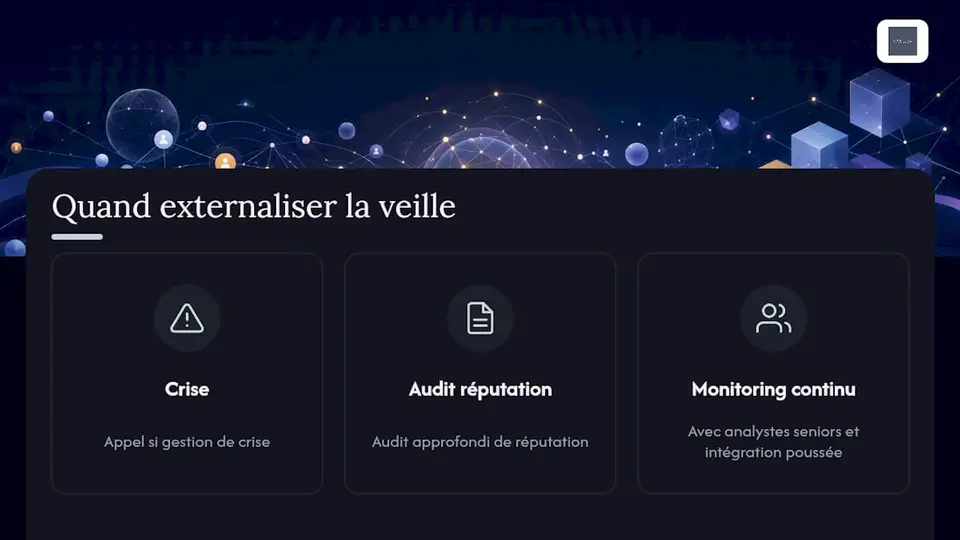
As soon as the assignment involves crisis management, an in-depth reputation audit, or ongoing monitoring that requires senior analysts and advanced data integration.