Content Atomization: A Practical Guide for Marketing Teams

Content atomization means taking one substantial piece of content (a white paper, a webinar, a research report) and breaking it into many smaller pieces that each work on their own, in the format and tone of the channel where they appear. Done well, it multiplies the reach of your best ideas without multiplying your production budget. Done badly, it fills a calendar with generic noise. At Wise Mirror, we link the two ends of the job: understanding what is said about your organization online, and producing and distributing content built to be found and cited, including by AI engines.
TL;DR
- Atomization starts from one dense pillar asset and plans the derived pieces before production, so each piece has a job and an audience.
- It differs from repurposing: repurposing changes the format of a piece, atomization extracts ideas and rebuilds them as new, native assets.
- The method has seven steps: choose the pillar, get a clean transcript, extract the ideas, decide what deserves publishing, adapt to each channel, sequence over weeks, measure by source asset.
- Speed comes from automation, credibility comes from editorial judgment: a human must decide what is worth distributing and keep the brand voice.
- Measure reach per pillar, cost per published piece and conversions, not volume alone.
Table of Contents
- What content atomization is, and what it is not
- Why it matters for communication and marketing teams
- Which assets deserve to be atomized
- The method in seven steps
- A worked example: one webinar, fourteen pieces
- Keeping the voice: where automation helps and where it stops
- Measuring an atomization programme
- Where Wise Mirror fits
- Common mistakes to avoid
- FAQ
- Sources
What content atomization is, and what it is not
The idea is simple. You invest heavily in one asset, then extract its components: a claim, a statistic, a framework, a customer story, a list of steps, answers to frequent questions. Each one becomes an independent piece. A white paper of 3,000 words can become a dozen social posts, three blog articles, an infographic and a webinar deck, with every piece delivering value alone while reinforcing the central message.
Three terms get mixed up, so here is the difference in plain words:
| Term | What it does | Typical output |
|---|---|---|
| Repurposing | Moves a finished piece into another format | One blog post becomes one video |
| Atomization | Breaks a large asset into ideas, then builds new native assets from them | A report becomes posts, a carousel, an article, a short video, an email sequence |
| Distribution | Places assets in front of an audience and measures the response | Scheduling, channels, timing, targeting |
Mailchimp’s definition draws the same line: repurposing transforms one piece into another format, while atomization starts from a large content asset and creates new contents from it. In practice, atomization is a form of repurposing, but not all repurposing is atomization. And neither one works without a distribution plan: pieces nobody sees are only more inventory.
The practical difference is where the thinking happens. With repurposing, you ask what else a finished piece can become. With atomization, you plan the derived pieces before the pillar exists, so the pillar is written, filmed or recorded with its fragments in mind.
Why it matters for communication and marketing teams
Most communication teams have the same constraint: a limited team, many channels, and leadership that wants presence everywhere. Atomization answers that constraint directly. Martech.org lists three core benefits: broader reach and engagement because audiences prefer different formats, more output without more resources, and a SEO boost through niche keywords, internal links and a wider content footprint.
A fourth benefit matters more each year: visibility in AI answers. When ChatGPT, Perplexity or Gemini assemble a response, they draw on many pages that express a consistent point of view. A single pillar article is one signal. A pillar plus a family of coherent, well-structured derivatives (a definition page, an FAQ, a data article, a practitioner checklist) gives engines more clear, citable passages that state the same position. That is the logic behind the content we produce for clients, designed from the start to be cited by AI.
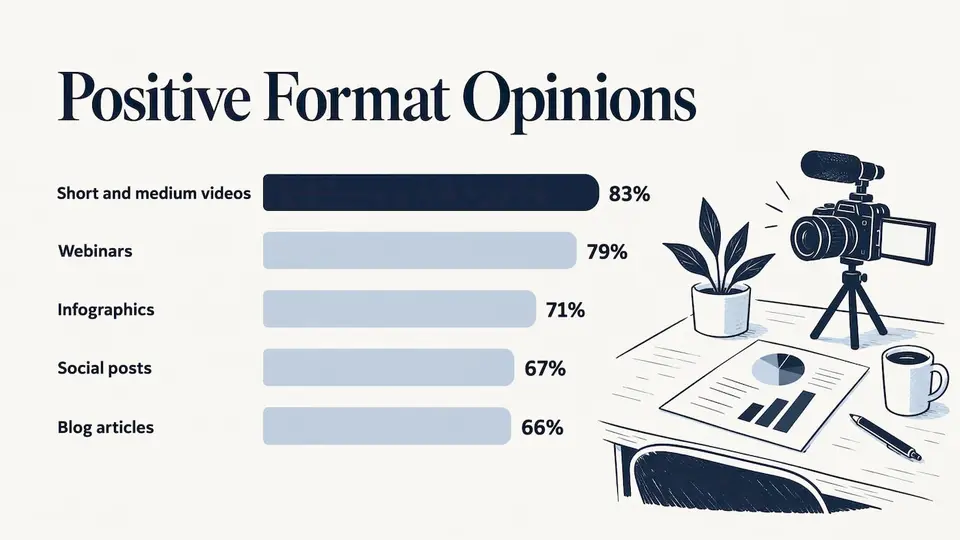
There is also a market reason to take format diversity seriously. In the first Infopro Digital barometer of B2B content in France (2025, 315 French B2B marketing decision makers), short and medium videos received 83% positive opinions and webinars 79%, ahead of infographics (71%), white papers and guides (70%), social posts (67%) and blog articles (66%). The gap between the best and the weakest of these formats is no more than 17 points: no single format wins alone, which is exactly why one idea deserves several formats.
Which assets deserve to be atomized
Not every file in your shared drive is a good pillar. A useful source passes three tests:
- Density. It contains enough material for at least three distinct angles. If you cannot extract three, it is too thin.
- Durability. Its substance will still be valid in six months or more.
- Strategic weight. It addresses a real business issue: a buying objection, a regulatory change, a flagship offer, a public-sector priority.
The formats that usually satisfy all three are the long interview or podcast, the in-depth article with a clear thesis, the recorded webinar or conference, the research report and the customer case study. A good shortcut is to start from signals you already have: the pages that bring the most organic traffic, the webinars with the longest watch time, the questions your sales team hears again and again.
For a public organization, the same logic applies to a consultation report, a annual activity review or a keynote by a director. For a private brand, it applies to a benchmark study or a founder’s talk. Whatever the source, choose at most one pillar a week. Most teams that try more end up with thin derivatives.
The method in seven steps
1. Choose one pillar and define its message
Write the central claim in one sentence before anything else. If you cannot, the asset is not ready. Decide who it is for and where that reader sits in the buying or decision journey. This editorial frame (brand identity, target audience, stage in the journey) stays fixed across every derived piece.
Where it goes wrong: choosing an asset because it exists, not because the idea is strong. A weak idea cut into twelve pieces gives twelve weak pieces.
2. Get a clean transcript
For audio and video sources, transcribe the full content and correct it. Product names, acronyms and speaker attributions must be right, because errors in the transcript spread into every derived piece, especially when AI tools generate the first drafts.
Where it goes wrong: trusting automatic transcription blindly. Ten minutes of proofreading here saves hours of corrections later.
3. Extract the atoms
Go through the pillar and list its components: the core claim, two or three figures with their source, quotable sentences, a framework or process, definitions, an example or story, objections and the questions they raise. A 30-minute video or a 2,000-word article typically yields ten or more candidate angles.
Where it goes wrong: extracting sentences instead of ideas. A fragment copied from the original is not an atom. An atom can stand alone and still makes sense to someone who never saw the pillar.
4. Decide what deserves distribution
This step is editorial, and it is the one a machine cannot do for you. Of ten candidate ideas, expect about six to be publishable, two to be strong and two to be dropped. Keep the ones that sharpen your point of view and that your audience actually needs.
Where it goes wrong: publishing everything because it is available. Atomization is not calendar filler. Its real strength is spreading a small number of sharp messages across many assets, so choose the messages first and the deliverables second.
5. Adapt each atom to its channel
Each piece should feel native to its platform. A LinkedIn post opens with a hook on the first line. A newsletter section develops one idea and carries one call to action. An infographic makes the logic visible in a few seconds. Pasting a blog paragraph into a social post is cross-posting, not atomization.
Two checks protect quality at this stage. First, accuracy: delete any claim the source does not support and make sure every figure still carries its origin. Second, consistency: tone and detail level change from one format to another, but the message does not.
This is the stage where manual production reaches its limit. Our ZANNI platform is built for it: it generates more than 1,000 content variants per brief and distributes them across more than 9 platforms, with a 5-week setup. The brief is where your editorial frame and message are fixed, and the variants follow from it.
6. Sequence over three to four weeks
Give every piece a date before it is written. A simple rhythm works for most B2B teams: week one launches the strongest angle, week two goes deeper on details and objections, week three resurfaces the best performer and catches the audience that missed the first round. Space the pieces out, and cross-promote between channels so each one points to the others.
Where it goes wrong: publishing all derivatives the same day. The audience sees the same message five times in one afternoon and the algorithm gets no time to react.
7. Measure by source asset
Track results per pillar, not just per post. The next section details the indicators.
A worked example: one webinar, fourteen pieces
Take a 45-minute webinar for a regional authority presenting a new digital service for businesses. The pillar is the recording and the slide deck.
- Written long form: one recap article of about 1,500 words, with a short FAQ section structured so that AI engines can extract the answers.
- Short video: three clips of 30 to 60 seconds, each on a single question from the audience, with subtitles.
- LinkedIn: five standalone posts (one on the central claim, one on a figure, one on a customer story, one on a common objection, one with the three practical steps) and one carousel of eight slides.
- Email: one newsletter section with a single call to action to the replay.
- Sales and partners: a one-page summary for advisers and partner organizations.
- Visuals: two quote cards from the speakers.
That is fourteen pieces from one 45-minute investment, planned over four weeks, each with its own angle. The numbers are an illustration of the method, not a benchmark: what matters is that every piece has a distinct job.
Keeping the voice: where automation helps and where it stops
Automation is excellent at the skeleton: transcripts, first drafts, resizing, subtitles, scheduling. It does not choose the message and does not carry your voice. The risk of letting a tool produce fifteen formats without review is generic content that erodes credibility even as volume rises.
A workable division of labor:
- Machine: transcription, first-pass extraction, format variants, scheduling.
- Human: choosing the pillar and the message, deciding what to publish, checking facts and tone, approving the final version.
This is the principle behind how we work: AI-enabled analysis and production, paired with human strategic judgment, adapted to the operational constraints of your team.
Measuring an atomization programme
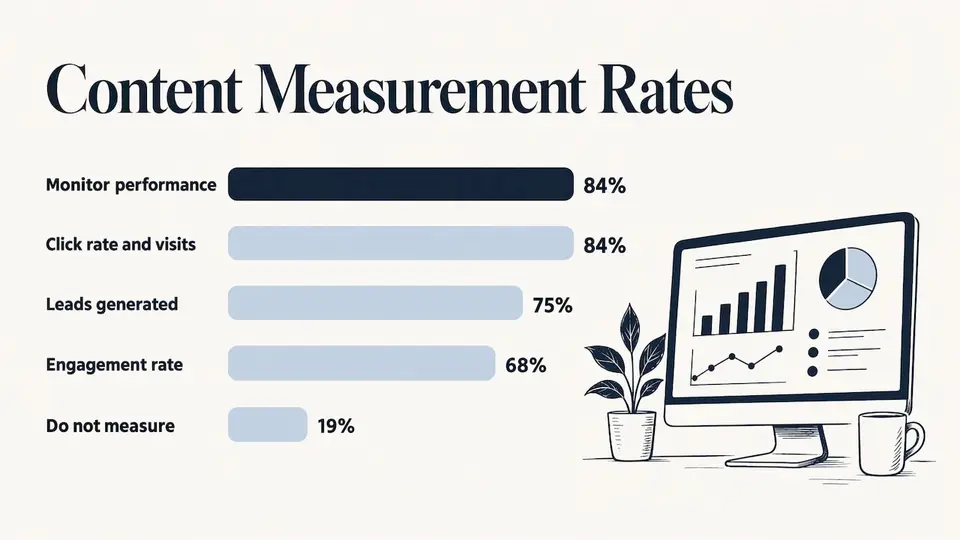
The Infopro Digital barometer shows that 84% of French B2B marketing decision makers monitor content performance, mostly through click rate and visits (84%), leads generated (75%) and engagement rate (68%), while 19% do not measure their content at all. Without measurement, no return on investment can be demonstrated, and atomization is the kind of programme leadership will ask you to justify.
Three indicators are enough to start:
- Reach per pillar: total people reached across all formats derived from one source asset.
- Cost per published piece: production time divided by the number of pieces published. If it does not fall over successive cycles, the process is not getting more efficient.
- End-of-funnel conversion: leads, registrations or meetings attributed to the pillar’s family of content.
Add two more as soon as your tools allow: search lift (impressions, click-through rate and positions in Search Console) and visibility in AI answers, meaning how often your brand is mentioned or cited when engines answer questions in your field. Treat attribution carefully: content influence usually shows as correlation across several touchpoints, not a single clean cause.
If reach does not grow and cost per piece does not drop, look first at the quality of the pillar and at whether the adaptation to each format was lazy.
Where Wise Mirror fits
Atomization raises two questions that content production alone does not answer: what should the pillar say, and is it working? We cover both ends in one engagement.
On the understanding side, our social listening audit analyzes what is said about your organization online over 6 weeks, across 6 dimensions, so your pillar addresses real conversations instead of internal assumptions. Our SEO, GEO and LLM audit examines your visibility in AI engines, with a light version in 24 hours and a full version in 2 weeks covering 7 engines, along with an action plan.
On the production side, SEO/GEO Response is our content production service for articles designed to be cited by AI, with daily production, at €1,000 excl. VAT per month. For multi-platform activation, ZANNI turns a brief into more than 1,000 variants distributed across more than 9 platforms. And continuous monitoring and alerts, at €5,000 excl. VAT per month, give you live dashboards and a monthly report to read the results by source asset. You can see how the pieces fit on our offers page, and our guide to social content activation goes further on distribution.
If you want a first read before committing to a larger engagement, our Diagnostic I.A., Diagnostic Social and Diagnostic LinkedIn are each priced at €800 one-off.
Common mistakes to avoid
- Volume as the only goal. Pursuing scale and efficiency alone leads to repurposing without purpose. Start with the message.
- No distribution plan. Assets without a schedule and audience are invisible.
- Same text everywhere. Each channel has its own grammar; each variant should bring something the others do not.
- Ignoring the pillar’s quality. Weak source, weak derivatives.
- Skipping review. Unsupported claims and unsourced benefits multiply across formats.
- Confusing atomization with the 70/20/10 rule. That rule describes the mix of an editorial calendar (educational, brand and promotional content). It helps you balance what you publish, but it says nothing about how to break a pillar down.
FAQ
What is the difference between content atomization and content repurposing?
Repurposing adapts a finished piece to another format, usually after publication. Atomization breaks a substantial asset into independent ideas and rebuilds each as a new, native piece, ideally planned before the pillar is produced. Atomization is a specific, more demanding strategy within the wider field of repurposing.
How many pieces can one asset produce?
It depends on the density of the source. A webinar or a 3,000-word white paper commonly yields between ten and thirty pieces across formats. If you cannot extract three distinct angles from a source, it is probably too thin to atomize.
How long should the derived content be spread over?
Three to four weeks works well for most teams: launch the strongest angle first, go deeper on details and objections in the second week, then resurface the best performer in the third. Publishing everything at once wastes the effect of repetition across contexts.
Does atomization help visibility in AI engines?
It can. A family of consistent, well-structured pieces (definitions, FAQs, data articles) gives AI engines several clear passages to draw on. Our guide to AI-optimized content explains how to structure those pieces so they can be cited.
Who should run an atomization programme internally?
The editorial decisions belong to the communication or marketing lead, who owns the message and the voice. Analysts can track the indicators and production partners can handle the volume, but the choice of what to publish stays with a person who knows the brand.
Sources
- Content atomization: Maximize ROI by repurposing your best ideas (Martech.org)
- 1st barometer of B2B content in France, 2025 (Infopro Digital)
- How to Leverage Content Atomization for Marketing Success (Mailchimp)
- What Is Content Atomization? A Marketer’s Guide (Aprimo)