Public Sector Strategic Intelligence: 2026 Guide

Public organizations process a volume of information every day that no one can absorb without a clear method. New regulations, tenders, institutional restructuring, weak signals on social media: public sector strategic intelligence has become a discipline in its own right, often described as economic intelligence applied to the public sector. Without a structured system, your decisions are always one step behind. This guide shows you how to build an effective intelligence process while accounting for the organizational, regulatory, and technological characteristics of your environment.
Table of contents
- Key takeaways
- Public sector strategic intelligence: definition and characteristics
- Stakeholders and organization of public sector intelligence
- Regulatory and public procurement monitoring
- Technologies to strengthen public sector intelligence
- Best practices and mistakes to avoid
- My perspective on the future of public sector intelligence
- How Wise-mirror supports your public sector intelligence
- FAQ
Key takeaways
| Point | Details |
|---|---|
| Distinguish strategic intelligence from BI | Strategic intelligence focuses on external factors; do not confuse it with analyzing your internal data. |
| Cover the entire regulatory lifecycle | Monitor legislation in development and implementing decrees to anticipate practical requirements. |
| Automate public procurement monitoring | With 200,000 notices published annually, manual monitoring means missing critical opportunities. |
| Align intelligence with decision-making | A system without a clearly identified recipient in the decision-making chain delivers no tangible value. |
| Secure intelligence data | Government digital governance is evolving rapidly: build cybersecurity into your system from the outset. |
Public sector strategic intelligence: definition and characteristics
Strategic intelligence (in French) involves collecting, analyzing, and using external information to anticipate risks and support decision-making. In the public sector, this definition takes on a particular dimension: you are not tracking market share, but legislative developments, administrative restructuring, tenders, and current political trends that reshape your scope of action.
The distinction from business intelligence (BI) is fundamental. BI uses internal data, performance dashboards, and management indicators. Strategic intelligence, by contrast, looks outward: what is being voted on, regulated, funded, and decided outside your own systems. For a project officer in a local authority or public institution, the two approaches complement each other but are not interchangeable.
What to prioritize in your monitoring
Public sector analysis covers four broad categories of information:
- Regulatory and legislative: bills, ordinances, circulars, European directives
- Institutional and organizational: reforms of public bodies, transfers of responsibilities, agency mergers
- Commercial and contractual: tenders, public contracts, grants, calls for proposals
- Technological and digital: tools deployed by government, mandatory standards, emerging cyber risks
| Dimension | Public sector | Private sector |
|---|---|---|
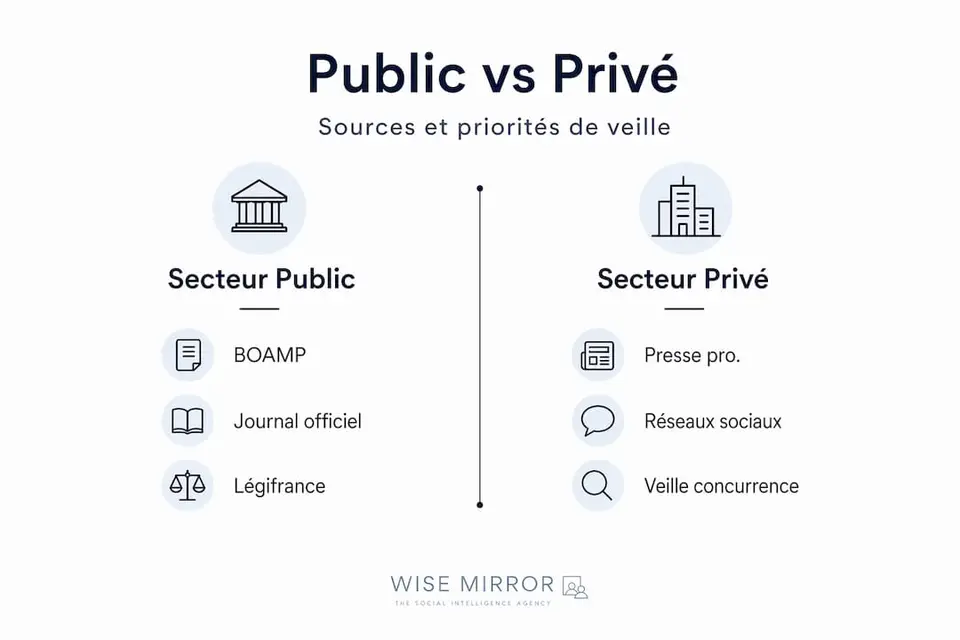
| Priority sources | BOAMP, Journal officiel, Légifrance, ministry websites | Business press, patent databases, market research |
| Timeframes | Long legislative cycles, fixed regulatory deadlines | Short competitive cycles, immediate opportunities |
| Stakeholders to monitor | Institutions, elected officials, national agencies, local authorities | Competitors, suppliers, customers, investors |
| Primary risks | Noncompliance, missed tenders, disinformation | Loss of market share, technological disruption |
Stakeholders and organization of public sector intelligence
Understanding who produces and distributes information in the public sphere is essential before structuring your own system. In France, the institutional landscape has just undergone a major change: DITP is becoming the public services directorate (in French), taking over DINUM responsibilities related to services for the public. This type of restructuring directly changes who publishes what and where to find reference documents.
Government digital governance (in French) is now more centralized, with practical implications for tool standardization and the security of public information systems. For your intelligence activities, this means monitoring not only published texts but also the governance decisions that determine which tools will be mandatory or recommended.

At the local level, networks such as France Services play a growing role in gathering information from citizens and communities. Including them in your monitoring scope helps you capture signals that central institutional channels do not always convey.
Here are the types of stakeholders to include in your intelligence map:
- Ministries and general secretariats (official publications, activity reports)
- Independent authorities (CNIL, Autorité de la concurrence, HATVP)
- National agencies and government bodies (ANCT, ANAH, ADEME, depending on your sector)
- European institutions (Commission, Parliament, OJEU for directives)
- Local networks and associations of elected officials (AMF, Régions de France)
Pro tip: Align your intelligence system with the institutional priorities calendar. When a major reform is announced, such as the DITP/DINUM merger, double your monitoring frequency for the relevant official publications during the six months following the announcement.
Regulatory and public procurement monitoring
This is often where intelligence delivers immediate operational value. Around 200,000 public procurement notices (in French) are published each year, and one in two companies misses a contract because it does not respond quickly enough. For public organizations, whether buyers or bidders, this figure illustrates the scale of the information flow to monitor.
Cover both phases of the regulatory cycle
Regulatory monitoring (in French) must distinguish between two separate timeframes. The upstream phase covers the development of legislation: public consultations, parliamentary reports, and draft texts under discussion. The downstream phase tracks implementation: decrees, orders, and interpretive circulars. Many public organizations monitor only the downstream phase, depriving themselves of a genuine ability to anticipate change.
Since 2024, eForms (in French) have made publishing public procurement notices easier and more secure. This format change directly affects monitoring tools, which must now be able to read and process these new data structures.
Key sources and methods
| Source | Primary use | Recommended frequency |
|---|---|---|
| BOAMP | National contract notices | Daily (automated alerts) |
| TED (Tenders Electronic Daily) | European contracts | Daily |
| Légifrance | Laws, decrees, ordinances | At least weekly |
| Buyer portals | Entity-specific procurement opportunities | Based on target portfolio |
| OJEU | European regulations in force | Weekly |
Here is a four-step approach to structuring your information collection effectively:
- Define your monitoring priorities: list the types of contracts, legal texts, and topics directly relevant to your mission or activities.
- Set up automated alerts: RSS feeds, official platform APIs, and BOAMP notifications using keywords and CPV codes.
- Centralize everything in one tool: avoid scattering information across inboxes, spreadsheets, and separate tools. An aggregator or dedicated platform reduces the risk of duplication and information loss.
- Sort and assess relevance before sharing: not every alert is relevant to every recipient. Filter information upstream to share only what requires action.
Automating notice feeds (in French) with deduplication substantially improves the efficiency of public procurement monitoring systems. Tools that incorporate APIs and contextualized alerts reduce processing time and limit oversights.
Technologies to strengthen public sector intelligence
Available tools have progressed well beyond basic email alerts. Social listening platforms can now capture weak signals in online conversations, on social media, in professional forums, and in specialist media. For public organizations, this creates a new capability: understanding perceptions of public policies before official feedback arrives.
Integration with business intelligence systems allows external intelligence data to be cross-referenced with internal performance indicators. This combination produces analyses that neither BI nor strategic intelligence can generate alone. For example, you can correlate a regulatory development identified through monitoring with its projected impact on your budget indicators.
Cyber defense challenges are also growing. The government plans to allocate 5% of ministries’ digital budgets to cybersecurity starting in 2027, with €200 million invested in detection tools and post-quantum cryptography. Your intelligence system is itself a potential target: the data you collect has value, and securing it cannot be an afterthought. For further insight into disinformation risks in the public sector, dedicated resources offer useful guidance.
Here are the criteria for selecting technology tools for effective public sector intelligence:
- Interoperability: the tool must integrate with your existing systems (document management, operational information systems, reporting tools)
- GDPR compliance and security frameworks: check certifications and data hosting arrangements
- Multiformat processing capabilities: official PDFs, XML feeds, structured eForms data, web content
- Alert configuration by user profile: each recipient should receive only relevant information
Pro tip: Do not deploy an intelligence tool without first validating its interoperability with your document management systems. An isolated tool creates additional information silos rather than reducing them.
Best practices and mistakes to avoid
Public sector competitive intelligence rarely fails for lack of sources. It fails because the decision-making chain lacks structure. The value of intelligence (in French) comes from its connection to the decision-makers who must act on the information received. Without a clearly identified recipient, even the best alert has no impact.
The most common mistake is producing an exhaustive weekly intelligence bulletin that nobody reads in full. Favor short, targeted formats geared toward a specific decision or action. For sector intelligence metrics, concise dashboards are far more effective than narrative summaries.
Here are the key considerations for sustainable public sector intelligence:
- Align with real needs: ask decision-makers about their actual questions, not what they think they want to know
- Formalize the decision-making chain: who receives what, who validates it, who acts, and within what timeframe
- Eliminate outdated sources: a source that has not produced useful information in six months should be reassessed
- Set an update schedule: some areas require daily monitoring (public procurement), others weekly monitoring (regulatory developments)
- Document your methods: intelligence activities must survive changes in roles or teams
Economic intelligence training (in French) emphasizes aligning the intelligence system with users’ actual operational needs. This is an essential condition for intelligence that produces decisions, not just reports.
My perspective on the future of public sector intelligence
Over the past several years, I have observed a clear trend: public organizations invest in tools but underinvest in methodology. They buy intelligence platforms, configure alerts, and digitally recreate the same silos they had on paper.
What is missing, in my view, is a culture of actionable intelligence. Collecting information is the start of the work, not the end. Real value is created through interpretation, contextualization, and delivery to the right decision-maker at the right time. In public organizations, this requires cross-departmental collaboration that traditional organizational structures do not naturally encourage.
I am also convinced that, by 2027, centralized digital governance will impose standards that organizations failing to anticipate them will experience as constraints. Those that have incorporated these developments into their monitoring will see them as opportunities. This is precisely the difference between observing public policy from a distance and practicing integrated intelligence that genuinely informs strategy.
— GB
How Wise-mirror supports your public sector intelligence
Building an intelligence process that delivers value in the public sector requires appropriate tools, a rigorous methodology, and analytical capabilities that internal teams do not always have time to develop on their own.

Wise-mirror combines advanced social listening, artificial intelligence, and senior analyst expertise to decode weak signals, monitor institutional reputation, and map the influence ecosystems that matter to your organization. Whether you need a one-off positioning audit, continuous monitoring, or a rapid response capability during a crisis, Wise-mirror’s public sector social listening services are designed to address the specific challenges facing public and semi-public organizations. Discover how to turn observation into decision-making at wise-mirror.fr.
FAQ
What is strategic intelligence in the public sector?
Public sector strategic intelligence involves collecting and analyzing external information (regulatory, political, and technological) to anticipate risks and support decision-making by leaders and project officers.
Which sources are essential for effective regulatory monitoring?
BOAMP, TED, Légifrance, and buyer portals form the minimum foundation. Monitoring must cover both the development of legal texts (upstream) and their implementation through decrees and circulars (downstream).
How can I improve strategic intelligence in my public organization?
Start by aligning the system with your decision-makers’ actual needs, formalize the information-sharing and action chain, then automate collection from priority sources to free up time for analysis and interpretation.
Why is automation essential for public procurement monitoring?
With around 200,000 notices published each year, manual monitoring inevitably creates delays that cost opportunities. Automated API and keyword alerts enable you to respond within the deadlines set by tender procedures.
Which digital risks should public sector intelligence cover in 2026?
Monitoring must now incorporate cyber risks and changes in government digital governance, particularly new security standards and standardization decisions that affect public organizations’ information systems.